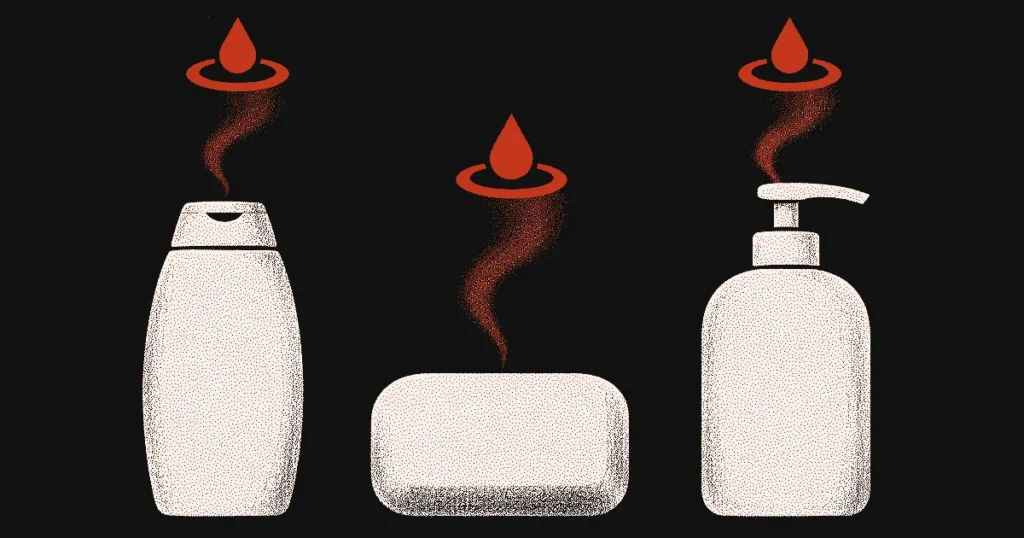
Pick up your shampoo and read the back. You may not find the word “formaldehyde” anywhere. You might find DMDM hydantoin or quaternium-15 instead, and those are preservatives that release formaldehyde. The label doesn’t say so, which leaves it to you to recognize the names.
Evidence key Strong Moderate Weak How we grade
The word that isn’t on the label
Start with the names. None of them says what it does.
Formaldehyde-releasing preservatives are not labeled 'formaldehyde'; the commonest in US products were imidazolidinyl urea (7.0%), DMDM hydantoin (5.4%, and 12.6% of rinse-off products), diazolidinyl urea (4.5%) and quaternium-15 (1.4%). Moderate evidence. De Groot 2010
This is how common they were in one registry.
In 2008, about one in five (19.5%, 6,463 of 33,212) cosmetics and personal care products in the US FDA's voluntary registry contained a formaldehyde-releasing preservative, including 27.3% of rinse-off products and 16.9% of leave-on products. Moderate evidence. De Groot 2010
Even a “formaldehyde-free” claim has been shaky in at least one product category.
Formaldehyde can be present in a product without being declared: it was found above 2 ppm in nail polishes marketed as formaldehyde-free, and it can form from releasers, surfactants, or packaging resins in cosmetics. Moderate evidence. Goossens 2022
The people who most need to read these labels say they’re the hardest to read.
People allergic to formaldehyde or methyldibromo glutaronitrile (MDBGN) have an especially hard time reading ingredient labels, likely due to long chemical names and formaldehyde's many synonyms and releasers; ask a dermatologist to write down or print the specific names and synonyms to watch for. Moderate evidence. Noiesen 2007
How formaldehyde is classified
One older cancer-agency list ranks formaldehyde in its top group.
IARC's alphabetical list (last update November 2018) printed formaldehyde (Vol 100F, 2012), benzene, ethylene oxide, trichloroethylene and vinyl chloride as Group 1, carcinogenic to humans, as of that date. Strong evidence. IARC 2018, Agents Classified by the IARC Monographs, Vols 1-123
That list ranks hazards. It doesn’t measure the risk from a bottle of shampoo, and we haven’t graded anything that does. The graded evidence on these preservatives is mostly about allergy.
Dermatologists have known about these allergies for decades
Quaternium-15 led this older US list.
Quaternium-15 was the single most frequent identified preservative allergen (65 reactions), ahead of imidazolidinyl urea (21), parabens (19), bronopol (16) and formaldehyde (16). Moderate evidence. Adams & Maibach 1985
Reported patch-test results for it also differed between North American and European clinics. The series and test concentrations weren’t the same, so read these as referral-clinic figures, not rates for everyone.
Among people sent for patch testing, quaternium-15 caused a positive reaction in about 9% in North American centers (7.1-9.6%) but about 1% in Europe (0.6-1.9%); the other formaldehyde releasers scored roughly 1-4%. Moderate evidence. De Groot 2010
Some of those numbers have come down since then, but formaldehyde itself went the other way.
Patch-test reactions to formaldehyde-releasing preservatives (quaternium-15 3.6%, bronopol 1.3%, imidazolidinyl urea 1.1%, DMDM hydantoin 0.8%) were significantly lower in 2015-2016 than the 2005-2014 pooled rates while reactions to formaldehyde itself rose to 8.4% (2% aq), and preservative substitution toward MI was expected by the authors to keep changing sensitization rates. Moderate evidence. DeKoven 2018
A test for formaldehyde alone can miss people who react to these preservatives.
About one in three Spanish patients allergic to formaldehyde or a releaser (74 of 209) reacted only to releasers, not to formaldehyde itself, so a formaldehyde test alone would have missed them. Moderate evidence. Latorre 2011
Formaldehyde-releasing preservatives (quaternium-15, DMDM hydantoin, diazolidinyl urea, imidazolidinyl urea, bronopol) can cause allergy through the formaldehyde they release or, for some, through their breakdown products, so a negative formaldehyde patch test does not rule out releaser allergy. Moderate evidence. Goossens 2022
A positive patch test doesn’t name the product behind a rash, though.
Whether a positive patch test to a formaldehyde releaser matters in daily life is poorly documented: only 8 of 33 cited studies reported relevance, the figures ranged from 7% to 90%, and none named the causative products. Moderate evidence. De Groot 2010
North America and Europe
Look at how far apart the referral-clinic figures are.
In patch-tested patients, allergy to formaldehyde and its releasers was about 8% in North America against about 1.5-2.5% in Europe, and quaternium-15 alone was 7.7% in the US vs 0.7-1.7% in Europe. Moderate evidence. Goossens 2022
The reviewers read that gap as a result of looser US rules. That’s their interpretation, and the review didn’t test it. We haven’t graded the current EU labeling rules for formaldehyde, so we won’t describe them here.
When scent chemicals meet ozone indoors
Preservatives aren’t the only route to formaldehyde at home. One New Jersey study found more of it indoors than outdoors. It didn’t pin that on scent, and building materials were a major source.
Formaldehyde in New Jersey homes averaged 55 parts per billion indoors versus 13 outdoors; compared home by home, indoor levels averaged about seven times the outdoor level (mean indoor/outdoor ratio 7.2). Strong evidence. Weisel 2002
Separately, scent ingredients can form formaldehyde when ozone is present.
Terpene ingredients in scented cleaners, air fresheners, perfumes, colognes and essential oils (limonene, pinene, linalool, linalyl acetate) are listed as ozone-reactive indoor sources that make formaldehyde and tiny particles when ozone is present. Strong evidence. Weschler 2006
Scent chemicals in cleaners and air fresheners react with ozone that drifts in from outdoors to make formaldehyde: cleaning raised formaldehyde by 9-16 ppb for 4 hours, and a plug-in air freshener raised it by about 6 ppb for as long as it ran. Moderate evidence. Singer 2006
Candles show a related pattern. In one chamber study, fragrance was the main driver of the extra emissions.
The fragrance added to a candle, not the wax it is made from, is the main driver of extra combustion emissions: unscented candles made from four different waxes (palm, paraffin, soy, stearin) formed the lowest-emission cluster in the study's statistical analysis, while scented versions of the same waxes released far more VOCs, PAHs, and formaldehyde. Moderate evidence. Salthammer 2021 Industry-funded
That chamber work also bears on ozone-generating devices.
How much formaldehyde and particle pollution formed was set mainly by how much ozone was available, not by how much product was used, so running an ozone-generating air purifier or ionizer alongside scented cleaning products or air fresheners adds directly to indoor formaldehyde and particles. Moderate evidence. Destaillats 2006
What you can do
For a persistent rash on the face, hands, scalp, or underarms, one expert review is specific about which tests to ask for.
If you have a persistent facial, hand, scalp, or underarm rash, ask for patch testing with formaldehyde 2% aq. and the releasers bronopol and diazolidinyl urea tested separately, because the older 1% formaldehyde test and formaldehyde alone miss cases. Moderate evidence. Goossens 2022
Dermatologists advise people allergic to formaldehyde to avoid formaldehyde-releasing preservatives too (bronopol possibly excepted if it tests negative), and people allergic only to a releaser to avoid that releaser. Moderate evidence. Goossens 2022
If a preservative allergy is proven, the advice is to get the exact names and synonyms in writing.
If you have a proven preservative allergy, check the label for the specific name and synonyms and ask your clinic for a written list: formaldehyde releasers, MCI/MI and parabens are the common preservatives, and 17-28% of creams in three studies were labeled incorrectly. Moderate evidence. Lundov 2009
A few certification labels screen these preservatives out. Each one shows what was excluded. None of them shows that what’s left is harmless.
Seal of Acceptance products must also exclude a named 34-ingredient Ecz-clusion List (including cinnamic alcohol, cinnamic aldehyde, coumarin, eugenol, farnesol, geraniol, hydroxycitronellal, isoeugenol, oak moss absolute, and several citrus extracts), chemical UV absorbers other than titanium/zinc/iron physical sunscreens, and formaldehyde releasers, in any amount. Strong evidence. NEA 2026
EWG Verified bans quaternary ammonium compounds, formaldehyde releasers, isothiazolinones, phthalates, PFAS, boron compounds, and nitro- and polycyclic musks (galaxolide) in licensed cleaners. Moderate evidence. EWG Verified criteria for cleaning products (10.24), Environmental Working Group, 2024
For the air at home, the advice comes from chamber work, not a home trial.
Reducing indoor ozone (for example, by filtering incoming air or limiting fresh-air intake on high-outdoor-ozone days) and avoiding heavy simultaneous use of terpene-scented products can reduce the formation of formaldehyde and fine secondary particles indoors, since both the ozone and the fragrance terpene are needed together to generate these byproducts. Moderate evidence. Fan et al. 2003
- Paste an ingredient list into our label decoder. Each preservative has its own page: DMDM hydantoin, quaternium-15, imidazolidinyl urea, diazolidinyl urea, bronopol, sodium hydroxymethylglycinate, and formaldehyde.
- If you use scented cleaners or plug-ins, don’t run an ozone-generating air purifier or ionizer alongside them. Better yet, drop the scented products.
- Ask brands why they use a preservative with a name you’d never connect to formaldehyde. You shouldn’t need a chemistry degree to wash your hair.
- Read more: shampoo and hair products, allergic or irritant rash, scented cleaning and your air, and scented candles.
Every claim above shows its evidence grade and names its source. See all the formaldehyde facts and the claims we won’t make. Information, not medical advice.