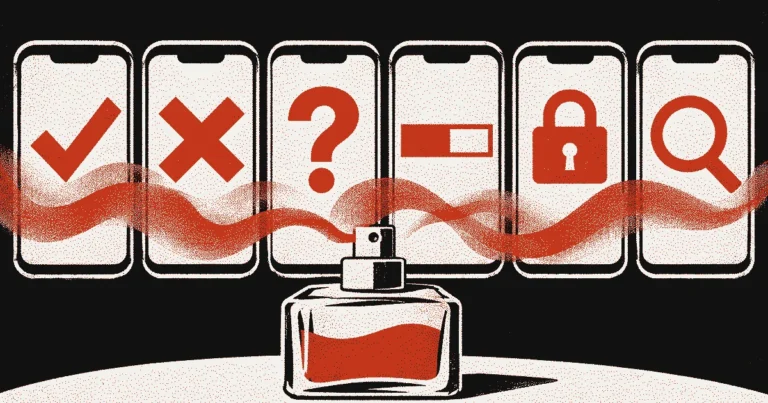
You’re in the shower with your eyes shut, and the whole stall smells like your shampoo. Then comes the conditioner, then the hair spray, and the bathroom fills up with scent. Shampoo, conditioner, and hair spray carry fragrance onto your scalp and into the air around you. Here’s what researchers have found in hair products, what the labels leave out, and how to wash your hair without the perfume.
Evidence key Strong Moderate Weak How we grade
What the label left out
In a small test of 18 hair products commonly used by Black women, most of what the lab found wasn’t on the label.
Only 16% of the chemicals detected above the testing limit in these hair products were listed anywhere on the product label; fragrance ingredients were almost never named individually, appearing instead as the single word "fragrance". Moderate evidence. Helm 2018
The fragrance-linked phthalate DEP was found in 78% of the hair products tested, and cyclosiloxanes, parabens, and DEP were found at the highest concentrations, including one anti-frizz product that was 38-46% cyclosiloxane by weight. Moderate evidence. Helm 2018
In that small sample, the products with the most banned or listed chemicals were marketed for kids.
Two no-lye hair relaxer kits marketed for children had the highest measured levels of chemicals banned in EU cosmetics or listed under California's Proposition 65 (DEHP, nonylphenol, o-phenylphenol, diethanolamine) of any products tested in this study. Moderate evidence. Helm 2018
Zoom out to a much bigger label survey.
In a 2010 survey of more than 11,000 Canadian personal-care products with ingredient lists, 'fragrance' or 'parfum' was the most common ingredient of concern, listed on 56% of products and on about two-thirds of shampoos, soaps, and deodorants. Moderate evidence. David Suzuki Foundation 2010
Shampoo shows up in allergy clinics
80% of patients allergic to oxidized linalool whose products were checked were using fragranced products, mainly shampoos, soaps, and creams. Strong evidence. Christensson 2012
Doctors have to look for it on purpose.
Standard allergy tests with fresh limonene and linalool miss most of these allergies, so European experts now recommend adding the oxidized forms to routine patch testing. Strong evidence. Ogueta 2022
Hair dye brings its own allergy risks.
Children have required hospitalization for severe allergic reactions to hair dyes (paraphenylenediamine). Moderate evidence. Brasch 2007
What hair products put in the air
You can’t see it, but a spray changes the air in the room.
In an office-sized test room with some ozone in the air, a single ordinary spray of perfume, body spray, or hair spray, or a dab of hand lotion, set off a burst of new ultrafine particles within minutes, reaching 34,000–200,000 particles per cubic centimeter, more than in many city streets. Moderate evidence. Wu 2024
Ventilation made a difference.
Ventilation and less ozone help: in the same test room, with lower ozone (25–30 ppb) and nearly 3× the air exchange, particle mass from perfume, hair spray, and body spray fell by more than half. Moderate evidence. Wu 2024
The UK’s official pollution inventory doesn’t count it.
The UK national air-pollution inventory counts zero emissions of limonene or the silicone D5 from shampoos, shower gels, and skin products, although these were the two largest emissions measured from them. Moderate evidence. Yeoman 2020
One survey of self-reported styling-product use looked at lung function. It found an association, not a proven cause.
In both men and women, more frequent use of hairstyle products (hairspray, gel, mousse) was associated with an approximate 2% decrease in FEV1, FVC, and the FEV1/FVC ratio. Moderate evidence. Dales 2013
Who counted how much people use
Here’s the amount a single spray puts on.
A single spray of perfume puts about a quarter gram of product on the skin (median 0.23 g per application), and a single hairspray application puts on about two grams from an aerosol can or three-and-a-half grams from a pump, based on a two-week diary-and-weighed-container study of regular users. Moderate evidence. Loretz 2006 Industry-funded
US women in this study used far more hair conditioner (28.2 g/day at the 90th percentile) and somewhat more eye shadow (0.052 g/day) than the amounts the EU's cosmetics safety regulator (SCCS) uses in its own risk-assessment formula for those same product categories (3.92 g/day and 0.02 g/day) — a 7.2-fold and 2.6-fold gap, unlike lipstick, where the EU and US figures are essentially identical when compared at the same percentile. Moderate evidence. Loretz 2008 Industry-funded
Those use numbers come from the people who sell the products.
The cosmetics industry generated its own dataset for how much facial cleanser, hair conditioner, and eye shadow people actually use, written by staff of the cosmetics trade association (CTFA), the fragrance industry's safety institute (RIFM), a contract statistics firm, and personal-care manufacturers including Procter & Gamble, Dial, Unilever, Johnson & Johnson, Mary Kay, L'Oreal, and Takasago, whose own conflict-of-interest statement says 'there are no conflicts of interest.' Moderate evidence. Loretz 2008 Industry-funded
No FDA approval before it’s sold
Under the US Federal Food, Drug, and Cosmetic Act, cosmetic products and ingredients, including hair products, require no FDA premarket approval, and the FDA does not regulate an ingredient unless evidence suggests it harms human health or the environment. Strong evidence. McDonald 2018
The industry’s own safety panel never got the breathing data, and published a “safe” verdict anyway.
In 1997 the cosmetics industry's own safety panel (CIR) formally asked for inhalation-toxicity data on benzyl alcohol, benzoic acid, and sodium benzoate, received none, and still published a 2001 "safe" conclusion that explicitly excludes any product where inhalation is a route of exposure (colognes, hairsprays, deodorants, aerosol fixatives). Strong evidence. Nair 2001 (CIR Expert Panel) Industry-funded
What you can do
Dermatologists already give fragrance-allergic patients this advice.
For fragrance-allergic people, dermatologists recommend removing diffusers, scented candles, room deodorizers, incense, and wax melts, switching household cleaners, wipes, and laundry products to fragrance-free, and bringing your own shampoo to the salon and your own oil to massages. Moderate evidence. Rodriguez 2024
- Switch your shampoo and conditioner to fragrance-free, and check the ingredient list with our label decoder or EWG Skin Deep. “Unscented” isn’t the same thing; here’s why.
- Bring your own fragrance-free shampoo to the salon. Ask them to skip the spray and styling products.
- If you use hair spray at all, open a window. A fan helps too.
- If your scalp, face, neck, or hands keep flaring, ask a dermatologist about patch testing that includes the air-oxidized fragrance allergens.
- Ask your salon to go fragrance-free. A printable sign or a letter makes the request easy to hand over.
- More on hidden fragrance: fragrance where you don’t expect it, why “natural” isn’t allergen-free, and what your skin absorbs.
Every claim above shows its evidence grade and names its source. See all the shampoo facts and the claims we won’t make. Information, not medical advice.