You’re standing in the aisle with a bottle of body wash in one hand and your phone in the other, hoping an app will tell you whether it’s free of fragrance. Yuka calls itself “a completely independent app that helps you choose the right products.” We tested it as someone avoiding fragrance. Before we could see a single product, it wanted an account. After that, searching by product name cost money, most beauty rankings were locked, and the app rated “Fragrance” as “Low risk.”
Evidence key Strong Moderate Weak How we grade
Everything about the app below is what we saw on an Android phone on October 3, 2026, using a free account. Apps change, so check yours. We have no connection to Yuka and earn nothing from it.
An account before anything else
After the welcome screens, Yuka showed a sign-up page with two choices: email or Facebook. There was no way to skip it. The back button just closed the app.
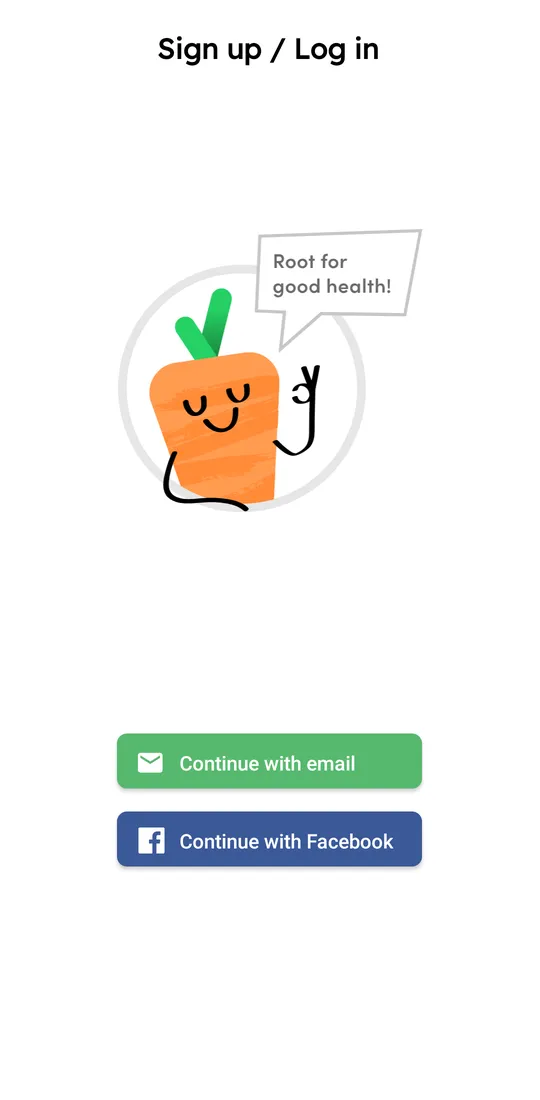
In our opinion, a health app that won’t show you anything until you hand over an email address has its priorities backward.
Searching by name costs money
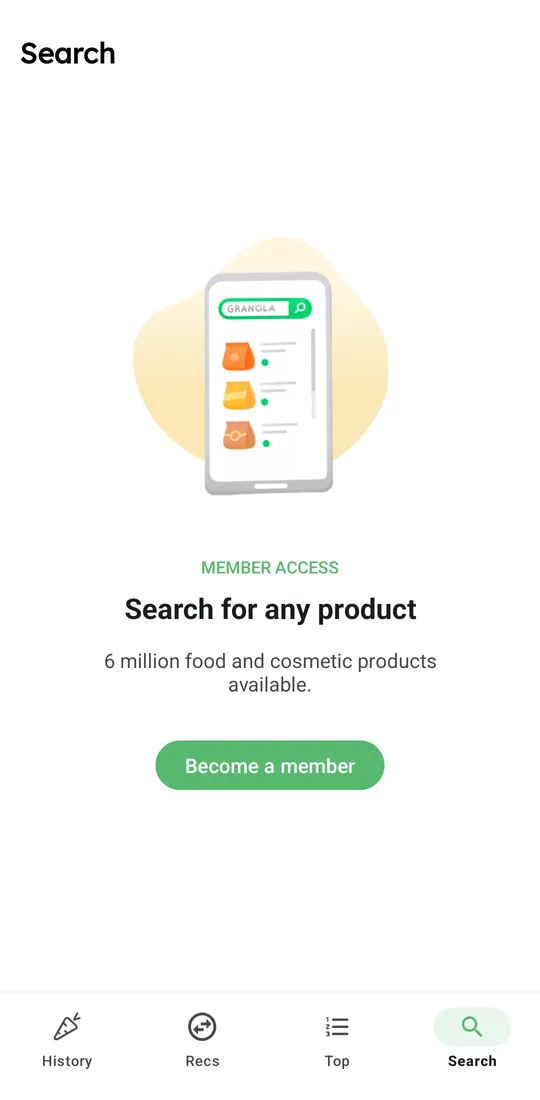
With a free account, the Search tab said “Member access.” We couldn’t look up a product by name without paying.
The membership screen offered “pay what you want,” set at $15 a year when we opened it. It listed search, food preferences, and offline mode. We saw nothing about avoiding fragrance or any other cosmetic ingredient.
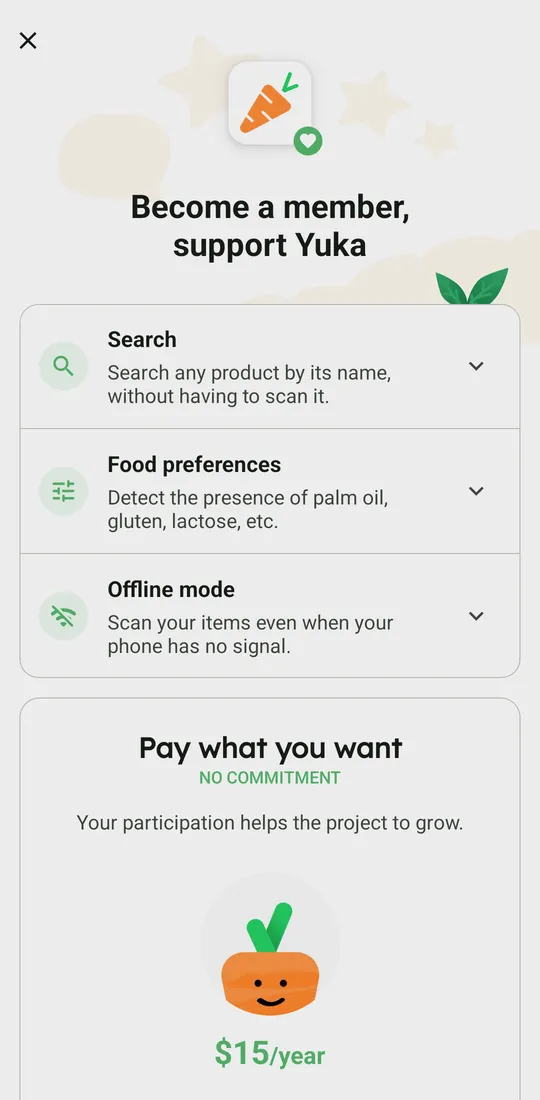
Looking a product up before you buy it is basic safety information. We think charging for it puts revenue ahead of the people the app says it’s helping.
Rankings behind “invite a friend”
The Top tab lists the best-rated products by category. On the Beauty side, three lists were open to us. The rest showed a lock and a prompt to “Invite a friend” to see the full list.
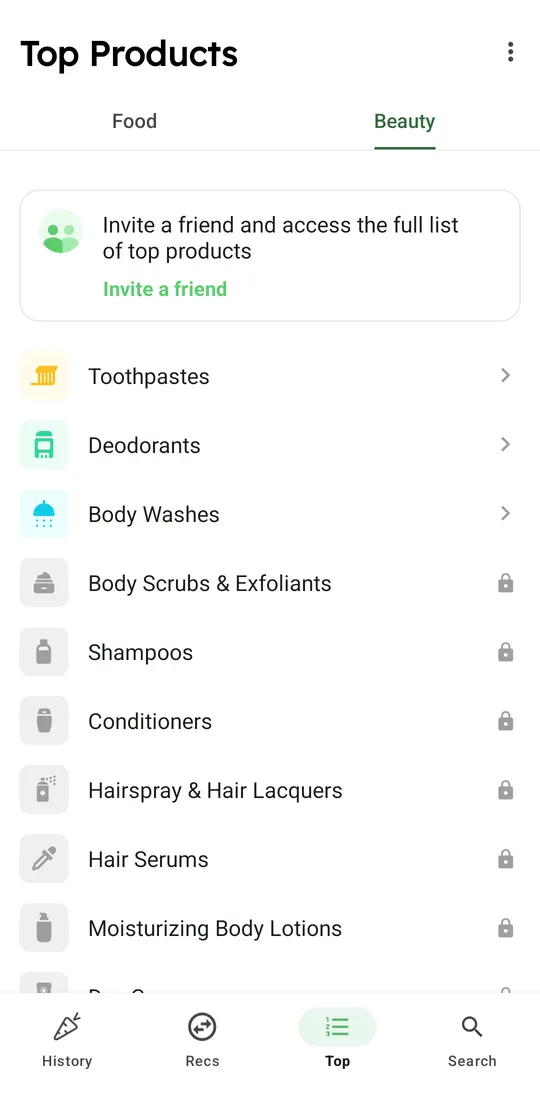
Making people send a referral before they can see the full shampoo ranking is a marketing choice. We don’t like it.
What it got right, and wrong, on body wash
Credit where it’s due: the top body wash on the open list was an unscented one, rated 100/100. Below it, though, came peppermint, vanilla, citrus, “wood barrel bourbon,” and coco vanilla washes, all rated “Excellent.”

An unscented wash on top is a good sign. A run of scented washes rated “Excellent” right behind it is the problem, and the next screens show why.
Fragrance as “low risk”
We opened the bourbon-scented men’s body wash. It scored 86/100, “Excellent.” Its ingredient list included “Fragrance,” marked “Low risk.”

Tap on “Fragrance” and Yuka’s own description lists two health risks, “Potential allergen” and “Potential irritant.” It also says US and Canadian rules don’t require companies to name what’s in a fragrance. Then it still labels it “Low risk.”

Yuka is right about the US disclosure gap.
Under US regulations, fragrance and flavor ingredients in a cosmetic can be listed simply as "Fragrance" or "Flavor" on the label, because the Fair Packaging and Labeling Act cannot be used to force a company to disclose trade secrets, and fragrance/flavor formulas are the cosmetic components FDA itself identifies as most likely to qualify. Strong evidence. FDA 2026 (Fragrances in Cosmetics)
For people with fragrance allergy, “low risk” leaves out a lot.
The standard fragrance patch test covers only 8 of the 82 fragrance chemicals known to cause allergy in people, so any single test undercounts fragrance allergy. Strong evidence. Alinaghi 2018
In a 5-year Danish patch-test survey of 17,716 eczema patients, 10.1% had fragrance allergy, and cosmetic products caused 42.1% of it; deodorants (25.3% of specific products listed) and scented lotions (24.4%) were the two leading culprits, together accounting for roughly half of all cases. Strong evidence. Heisterberg 2011
We don’t think an ingredient the app itself calls a potential allergen, whose formula a US label can reduce to the single word “Fragrance,” belongs anywhere near “low risk.”
We scanned a “fragrance-free” body wash
We scanned one bottle we had at home: Cetaphil Ultra Gentle Body Wash, labeled “Fragrance Free.” Its ingredient list includes heliotropine. The EU’s official cosmetic ingredient database, CosIng, lists “fragrance” and “perfuming” among heliotropine’s functions, and our label decoder flags the name for that reason. The label doesn’t say what heliotropine is there for, and a scan can’t tell you. We wanted to see whether each app would point it out.
Yuka rated it 37 out of 100, “Poor,” mostly over the preservative phenoxyethanol, which it rates “Moderate risk.”

Further down, it listed heliotropine as “Risk-free.” This is the same app that rated a bourbon-scented body wash 86, “Excellent.” By Yuka’s numbers, the scented wash wins. To be fair, the recommendations under the result came with a note that no brand pays Yuka to appear there.
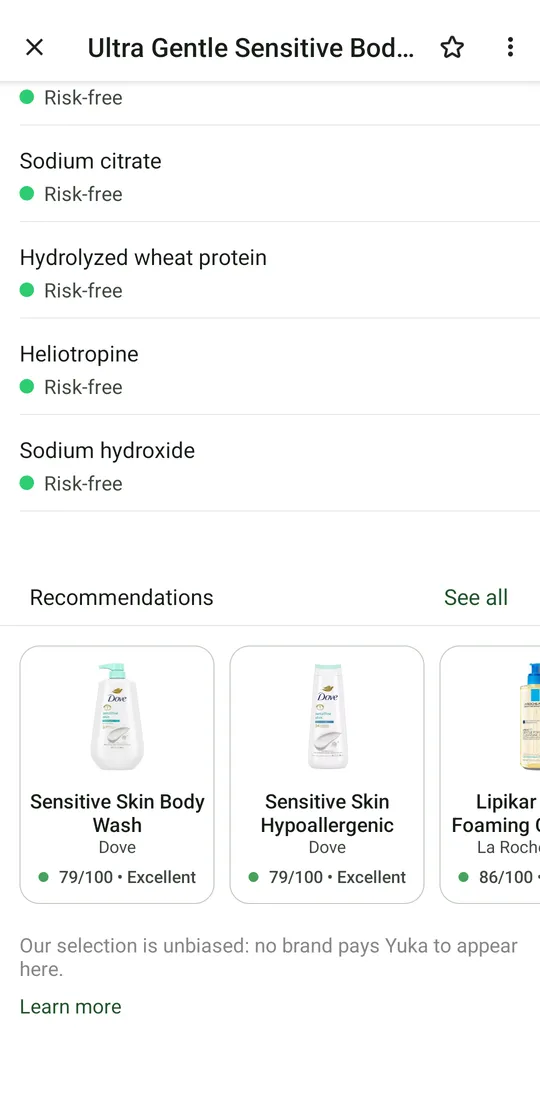
If fragrance is what you’re trying to avoid, we think Yuka’s score points the wrong way here.
Our one bottle isn’t the only reason to doubt a “fragrance free” label. A 2016 label survey of “fragrance free” body moisturizers found some listed ingredients that a dermatology allergen database flags for fragrance-allergic patients. That doesn’t prove added scent.
In a 2016 survey of 174 best-selling US body moisturizers, 18 of the 40 labeled "fragrance free" (45%) still listed at least one ingredient that dermatologists' allergen database (ACDS CAMP) flags for fragrance-allergic patients. Moderate evidence. Xu 2017
What you can do instead
- If you use the free barcode scanner, ignore the overall score and open the ingredient list.
- Look for “Fragrance,” “Parfum,” or named scent chemicals yourself. Don’t trust the color next to them.
- Use the open Body Washes list only as a starting point. Treat “unscented” or “fragrance-free” in a product name as a lead, not proof, and check the label.
- For anything you can’t scan, paste the ingredient list into our label decoder or check the ingredient guide. Both are free, with no account.
- If you’re allergic to fragrance, ask your dermatologist whether a checked product database is right for you. If you are allergic to fragrance, dermatologists advise avoiding all fragrance rather than only the chemicals you tested positive to, and choosing products from a checked database such as the ACDS CAMP list or SkinSAFE instead of trusting 'fragrance-free' claims. Moderate evidence. Rodriguez 2024
In fairness, one advocacy group’s report does list Yuka among free apps for spotting allergens.
This report recommends free consumer apps (Yuka, Tox Fox, Kemiluppen) and trusted ecolabels (Nordic Swan, EU Ecolabel) or fragrance-free certification labels (Asthma Allergy Denmark, Allergy Certified) as ways to identify or avoid suspected EDCs and allergens in personal care products. Weak evidence. Tegengif 2022
In the version we tested, though, name search required membership and most beauty rankings were locked. For a comparison, see our EWG app review, and for swaps that work without a score, the shopping guide.
App details are from our own test on October 3, 2026, using a free account, and may have changed. Opinions are ours. Research findings show their evidence grade and source. Screenshots are of Yuka’s app, shown for review. Information, not medical advice.