You’re standing in the aisle with a bottle in one hand and your phone in the other, hoping a green number will tell you it’s safe to bring home. EWG’s free Healthy Living app scans and rates personal care products, cleaners, and more. We tested it the way someone avoiding fragrance would: looking for fragrance-free products, checking a perfume, and searching for something without an ingredient list. It helps, as long as you know what it doesn’t show you. In one of our tests, a perfume got a green 2.
Evidence key Strong Moderate Weak How we grade
Everything about the app below is what we saw on an Android phone on October 3, 2026. Apps change, so check yours. We have no connection to EWG and earn nothing from it.
What the app does
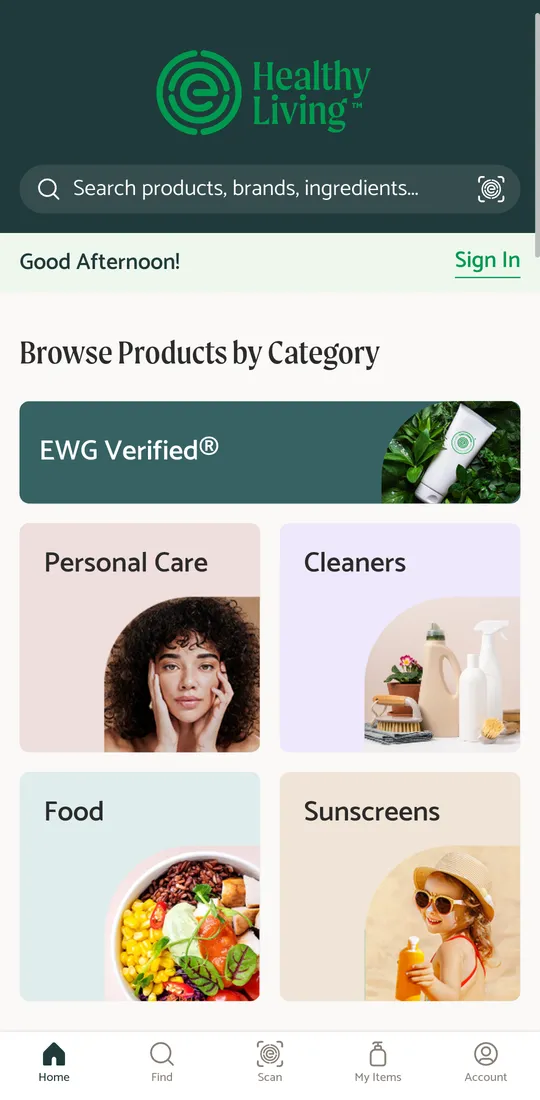
The app let us search by product, brand, or ingredient, or scan a barcode, with categories for personal care, cleaners, food, and sunscreens. The product pages we opened showed a hazard score from 1 (low) to 10 (high).
Even by EWG’s own ratings, perfume sits at the top of the hazard list. Of all personal care product types, perfumes and colognes had the highest hazard ratings in the Environmental Working Group's Skin Deep database, and adults aged 18–39 used the highest-rated ones (average 7.2 of 10, vs 5.9 for those 60 and over). Moderate evidence. Barrett 2025
Searching for fragrance-free works
Typing “fragrance free laundry detergent” brought up 18 products, starting with ones carrying EWG’s own Verified seal. That’s a faster start than reading labels in a store aisle, and it’s the app’s best trick.

Don’t trust a “fragrance free” label on its own, though. It deserves a second look. Products labeled 'fragrance free' have been shown to still contain fragrance ingredients, used as preservatives, masking perfumes, or botanicals. Moderate evidence. Johansen 2003, Am J Clin Dermatol 4(11):789-798 In a 2016 survey of 174 best-selling US body moisturizers, 18 of the 40 labeled "fragrance free" (45%) still listed at least one ingredient that dermatologists' allergen database (ACDS CAMP) flags for fragrance-allergic patients. Moderate evidence. Xu 2017
A green 2 on a perfume
This is the part that matters most if scent makes you sick, so look closely. We opened a men’s eau de toilette. Its overall score was a green 2, “Low Hazard.”

Scroll down and the same product is rated “High Hazard” for allergies and immunotoxicity.
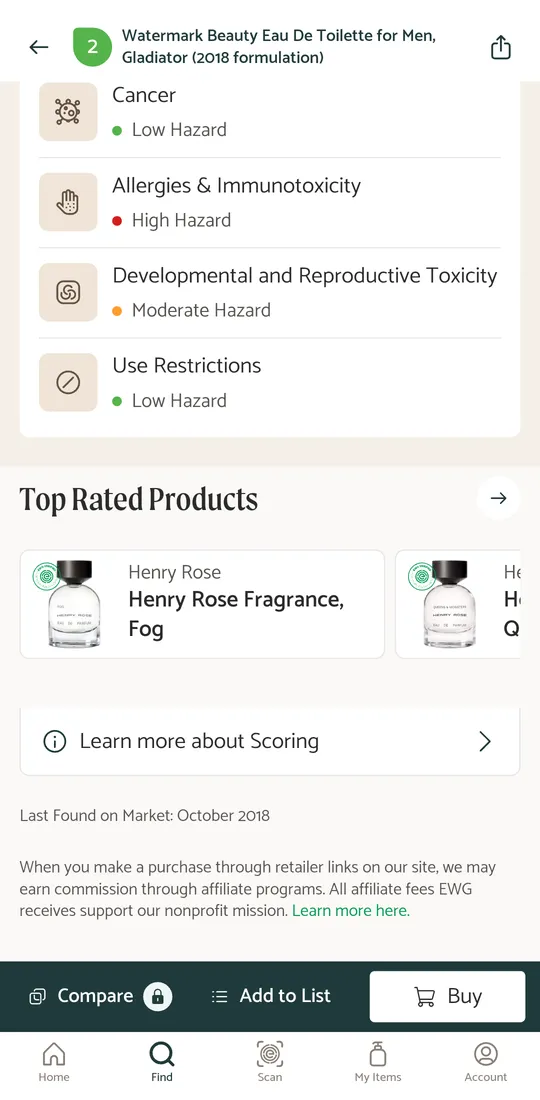
Open the Ingredients tab and “Fragrance” itself is rated 8, High Hazard. The product still scores a 2 overall. If you only glance at the big number, you’d never know.

The same screen then suggested “Top Rated Products”: another perfume. Yes, really.
“EWG Verified” doesn’t mean fragrance-free
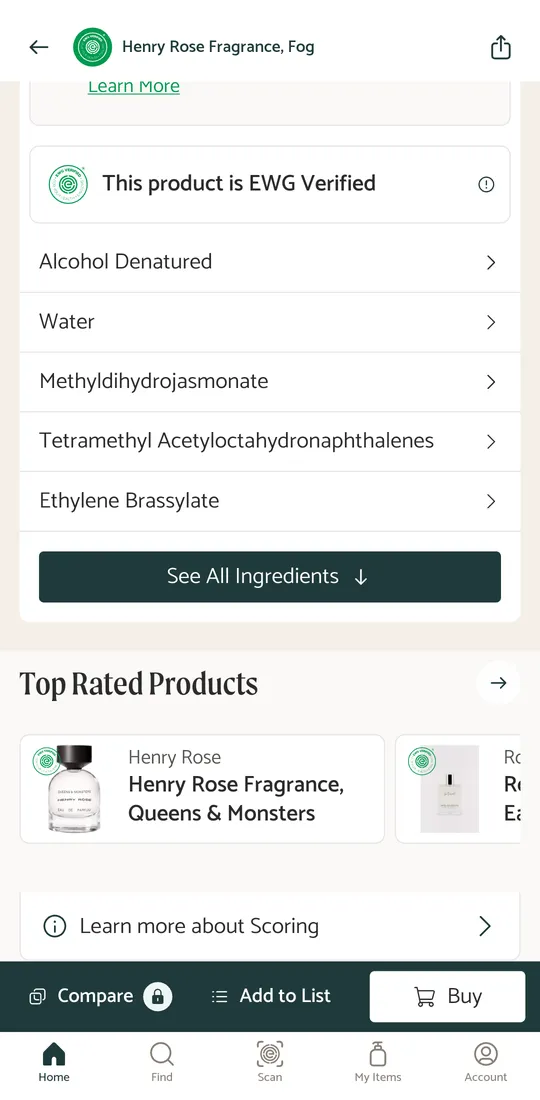
That suggested perfume carries the EWG Verified seal. Its ingredient list names the scent chemicals individually, instead of the single word “fragrance”: tetramethyl acetyloctahydronaphthalenes, ethylene brassylate, and methyldihydrojasmonate. That openness is worth something. It’s still perfume.
It also pays to know what the safety limits behind scents were built to do, and who they leave out. The industry's fragrance safety-limit system (QRA/IFRA Standards) is explicitly designed to prevent new fragrance allergies from developing, not to protect people who are already allergic from reacting to a compliant product. Strong evidence. Api 2020 (RIFM/IFRA) Industry-funded
Ingredient Preferences sit behind Premium
The app has “Ingredient Preferences” that check a product against what you want to avoid. When we tapped it, it asked us to sign in and said the feature needs Premium.
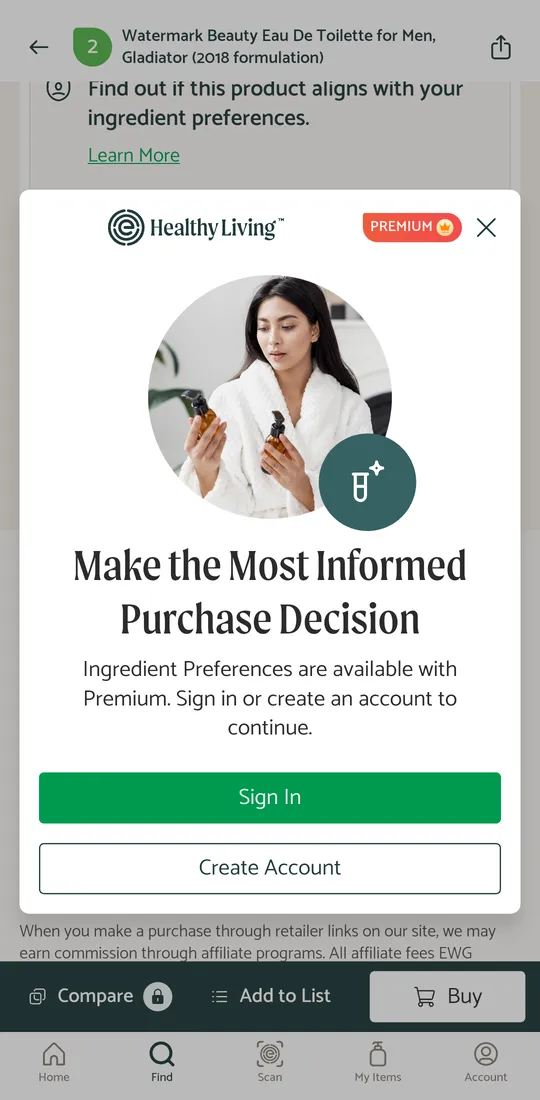
You can still check fragrance for free. It just means opening the Ingredients tab on every product yourself, every time.
When the app has nothing to say
We searched for trash bags, which we had no ingredient list to scan for. Nothing came up.

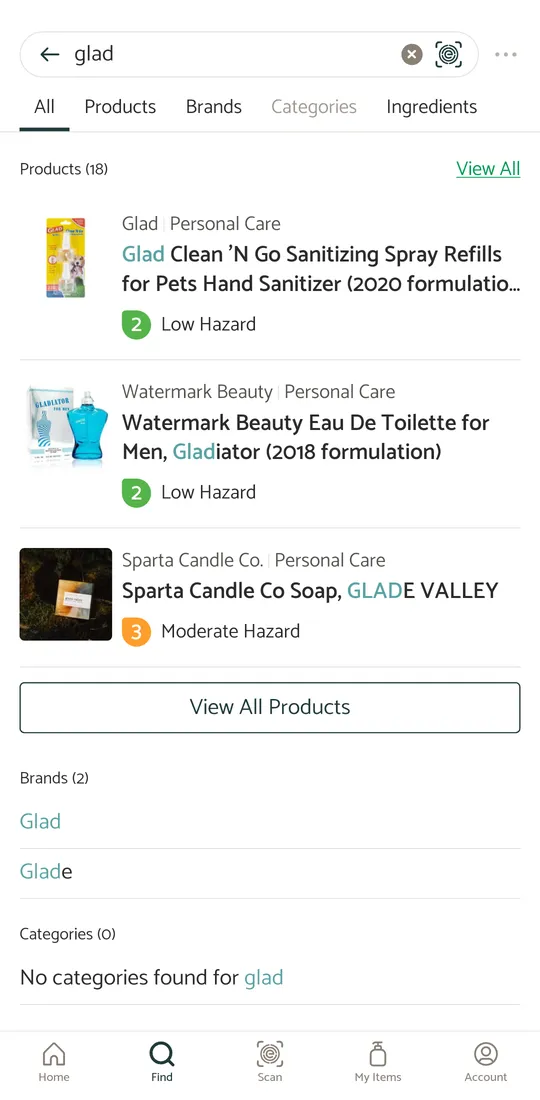
Searching the brand name Glad turned up sanitizing-spray refills for pets, but no bags.
The gaps aren’t limited to trash bags. A July 2022 look at EWG’s Skin Deep database found holes in personal care, too. About a third of the personal care products people actually used were not in EWG's Skin Deep database at all, including 39% of perfumes and nearly all intimate-care products, so their hazards could not be rated. Moderate evidence. Barrett 2025
What the score leaves out, and who pays EWG
Before you trust a single number, know what it measures. A Skin Deep score rates how hazardous the ingredients are flagged to be. It isn’t a measure of how much of them reaches you. EWG's own Skin Deep method says its hazard score "does not account for exposure or individual susceptibility": it ranks how hazardous an ingredient is flagged to be, not how much of it you are exposed to. Strong evidence. EWG Skin Deep methodology page (2026 capture) Skin Deep's method lists the product details EWG records (body area, leave-on vs rinse-off, spray, or powder form, intended age group), but its published scoring steps do not weight a product by concentration, amount applied, or leave-on use. Moderate evidence. EWG Skin Deep methodology page (2026 capture)
Then follow the money. EWG says most of its 2024 money came from donors and foundations, and some from companies that pay to use its mark. EWG says it raised $22.3 million in 2024: about 49% from individual donors, 31% from foundations, 9% from licensing and consulting fees (EWG Verified), 8% in-kind and miscellaneous, and 3% from events. Moderate evidence. EWG Funding & Reports page, 2026 EWG's own FAQ says EWG Verified is a paid program: typical fees are an application fee plus an annual licensing fee, varying by company size and number of products, but it publishes no amounts. Moderate evidence. EWG Verified FAQ, verified-portal.ewg.org, accessed 2026-10-16
Products with that mark come first in Skin Deep search results. EWG VERIFIED products must score in Skin Deep's green range and are listed first in Skin Deep search results, so the mark EWG licenses is promoted inside the database EWG scores. Moderate evidence. EWG, Skin Deep FAQ (web page, accessed 2026-10-16)
EWG's page names no foundation, corporate donor, or major donor; who funds EWG by name has to come from its Forms 990 or older annual reports. Moderate evidence. EWG Funding & Reports page, 2026
That isn’t industry funding in the usual sense. But a green score on an EWG Verified product comes from the group that sells the mark, so read that label as closely as any other.
The “fragrance-free” body wash test
We scanned one bottle we had at home: Cetaphil Ultra Gentle Body Wash, labeled “Fragrance Free.” Its ingredient list includes heliotropine. The EU’s official cosmetic ingredient database, CosIng, lists “fragrance” and “perfuming” among heliotropine’s functions, and our label decoder flags the name for that reason. The label doesn’t say what heliotropine is there for, and a scan can’t tell you. We wanted to see whether each app would point it out.
EWG found it right away and rated it a green 2, “Low Hazard.”

In the full ingredient list, EWG rated heliotropine a 3, “Moderate Hazard,” but nothing on the page called it a fragrance ingredient. Under this fragrance-free wash, “Top Rated Products” suggested Dr. Bronner’s castile soaps, starting with lavender.
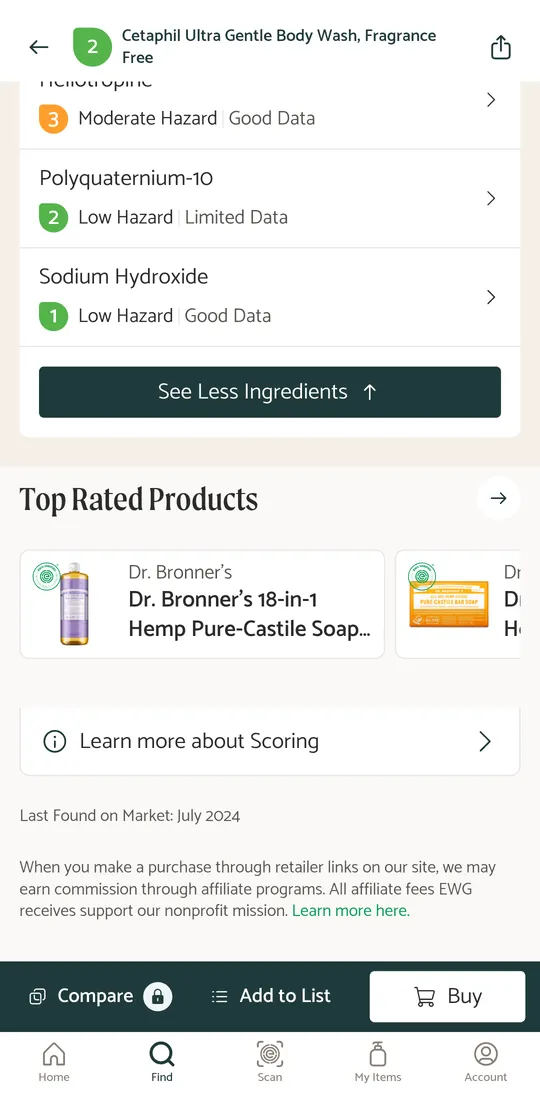
In our view, a scanner that answers a fragrance-free scan with scented soap isn’t built for people who avoid fragrance.
What you can do
- Don’t stop at the big score. Open the Ingredients tab and look for “Fragrance,” “Parfum,” or named scent chemicals.
- Search with “fragrance free” plus the product type, then still check each ingredient list.
- Don’t read “EWG Verified” as “fragrance-free.” Check the ingredient list.
- For products the app doesn’t have, paste the ingredient list into our label decoder, or check the ingredient guide.
- If you’re allergic to fragrance, ask your dermatologist about the allergen databases built for that. If you are allergic to fragrance, dermatologists advise avoiding all fragrance rather than only the chemicals you tested positive to, and choosing products from a checked database such as the ACDS CAMP list or SkinSAFE instead of trusting 'fragrance-free' claims. Moderate evidence. Rodriguez 2024
We also link EWG’s Skin Deep and Guide to Healthy Cleaning on our shopping guide. They’re useful. But in our test, neither a low score nor the EWG Verified seal told us whether a product was fragrance-free.
You shouldn’t need a second app, a Premium plan, and a chemistry degree to find out if a product has scent in it. Until labels say so plainly, ask for fragrance-free to be the default: take the pledge or join the community.
App details are from our own test on October 3, 2026, and may have changed. Research findings show their evidence grade and source. Screenshots are of EWG’s app, shown for review. Information, not medical advice.