You search EWG’s Skin Deep for perfume and the top results come back green: “Low Hazard.” We did exactly that. Then we opened one, and the first ingredient on its label was “Essential Oil Fragrance Blend (parfum).” EWG’s Skin Deep and Guide to Healthy Cleaning are still two of the best free places to find products without fragrance, and we send people to them all over this site. They work best when you know where to look, because a green score doesn’t always mean what you’d hope. Here’s how to use them when scent makes you sick.
Evidence key Strong Moderate Weak How we grade
Everything about the two websites below is what we saw on ewg.org on October 4, 2026. Ratings and pages change, so check what you see. We have no connection to EWG and earn nothing from it.
Who EWG is
EWG, the Environmental Working Group, describes itself on its website as a 501(c)(3) nonprofit. Its “Learn how Skin Deep works” page says it launched Skin Deep in 2004 to tell shoppers what’s in their cosmetics and personal care products. It also runs the Guide to Healthy Cleaning, a sunscreen guide, food scores, and the Healthy Living phone app, which we reviewed separately.
When we visited, the Skin Deep home page counted 154,895 products from 7,728 brands. Researchers use its ratings too.
And their ratings put perfume at the top.
Of all personal care product types, perfumes and colognes had the highest hazard ratings in the Environmental Working Group's Skin Deep database, and adults aged 18–39 used the highest-rated ones (average 7.2 of 10, vs 5.9 for those 60 and over). Moderate evidence. Barrett 2025
A perfume can score a 1
This is the part that matters most if scent is the problem. We searched for “eau de toilette” and sorted best to worst. The top results were perfumes, each marked green and “Low Hazard.”
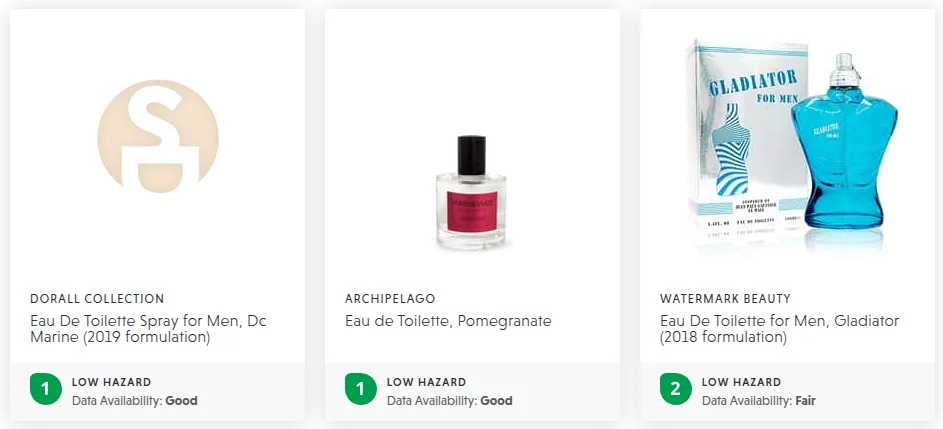
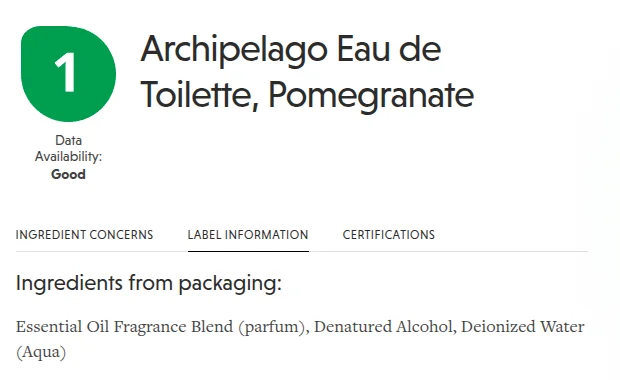
We opened one, a pomegranate eau de toilette rated 1. Its “Label information” tab shows the ingredients from the packaging, and the first one is “Essential Oil Fragrance Blend (parfum).”
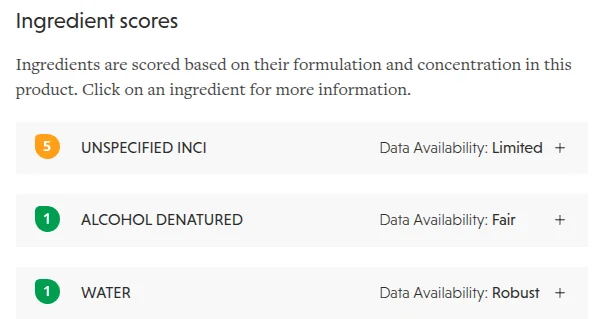
Switch to the ingredient scores and the word “fragrance” doesn’t appear. The list shows “Unspecified INCI,” rated 5, next to alcohol and water. The page doesn’t say which ingredient on the label that entry stands for.
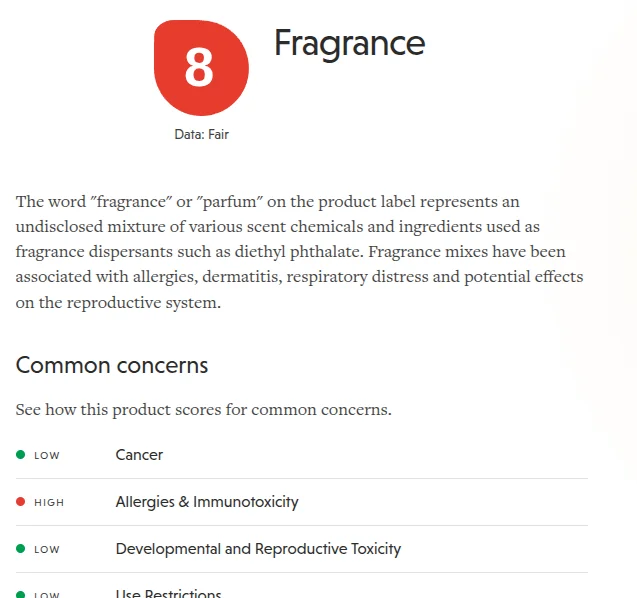
Skin Deep’s own page for the ingredient fragrance (parfum) rates it 8, with “High” for allergies and immunotoxicity. It calls the word an “undisclosed mixture of various scent chemicals.” That 8 doesn’t appear anywhere on the perfume’s own page.
EWG says a product’s score “is not an average of the ingredients’ hazard scores,” so we can’t tell from the page how the fragrance blend counted toward the 1. Either way, the lesson is the same: open the “Label information” tab and read the list yourself before you trust the color. Look for fragrance, parfum, aroma, and essential oil.
Searching Skin Deep: use the words on the bottle
Skin Deep covers personal care: soap, shampoo, lotion, deodorant, makeup, and perfume. Typing “fragrance free body wash” into the search box at ewg.org/skindeep brought up 66 products, led by ones with EWG’s own Verified seal. Every result had “Fragrance Free” in its name, because the search matches product names.
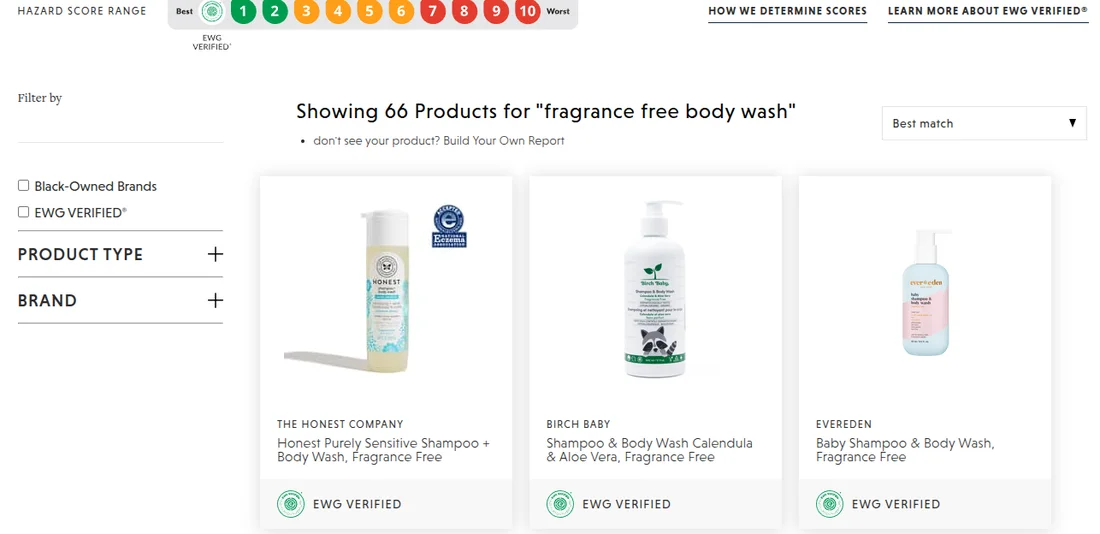
A “fragrance free” name is a good start, but check the list anyway.
Products labeled 'fragrance free' have been shown to still contain fragrance ingredients, used as preservatives, masking perfumes, or botanicals. Moderate evidence. Johansen 2003, Am J Clin Dermatol 4(11):789-798
Check the date, and notice what’s missing
Each product page has a “Data last updated” date. That pomegranate perfume’s said June 2022. Formulas change, so compare the list with the package in your hand.
Plenty of products aren’t in Skin Deep at all, perfumes among them.
About a third of the personal care products people actually used were not in EWG's Skin Deep database at all, including 39% of perfumes and nearly all intimate-care products, so their hazards could not be rated. Moderate evidence. Barrett 2025
If yours is missing, Skin Deep’s “Build Your Own Report” tool takes an ingredient list, or you can paste the list into our label decoder, which flags fragrance and the fragrance allergens the EU requires on labels.
“EWG Verified” isn’t the same as fragrance-free
EWG’s Verified page says products must give “full transparency to EWG, including fragrance ingredients.” That means the maker tells EWG what’s in the scent. It doesn’t mean there isn’t one. The newly verified products on that page the day we looked included a vanilla orchid deodorant, and in the app we found a Verified perfume. If scent is the problem, read the label of a Verified product the same way you’d read any other.
What the score leaves out, and who pays EWG
A Skin Deep score rates how hazardous the ingredients are flagged to be. It isn’t a measure of how much of them reaches you.
EWG's own Skin Deep method says its hazard score "does not account for exposure or individual susceptibility": it ranks how hazardous an ingredient is flagged to be, not how much of it you are exposed to. Strong evidence. EWG Skin Deep methodology page (2026 capture)
Skin Deep's method lists the product details EWG records (body area, leave-on vs rinse-off, spray, or powder form, intended age group), but its published scoring steps do not weight a product by concentration, amount applied, or leave-on use. Moderate evidence. EWG Skin Deep methodology page (2026 capture)
Now follow the money. EWG says most of its 2024 money came from donors and foundations, and some from companies that pay to use its mark.
EWG says it raised $22.3 million in 2024: about 49% from individual donors, 31% from foundations, 9% from licensing and consulting fees (EWG Verified), 8% in-kind and miscellaneous, and 3% from events. Moderate evidence. EWG Funding & Reports page, 2026
EWG's own FAQ says EWG Verified is a paid program: typical fees are an application fee plus an annual licensing fee, varying by company size and number of products, but it publishes no amounts. Moderate evidence. EWG Verified FAQ, verified-portal.ewg.org, accessed 2026-10-16
Products with that mark come first in Skin Deep search results.
EWG VERIFIED products must score in Skin Deep's green range and are listed first in Skin Deep search results, so the mark EWG licenses is promoted inside the database EWG scores. Moderate evidence. EWG, Skin Deep FAQ (web page, accessed 2026-10-16)
EWG's page names no foundation, corporate donor, or major donor; who funds EWG by name has to come from its Forms 990 or older annual reports. Moderate evidence. EWG Funding & Reports page, 2026
That isn’t industry funding in the usual sense. But a green score on an EWG Verified product comes from the group that sells the mark, so read that label as closely as any other.
The Guide to Healthy Cleaning: search “free clear” and “unscented”
The cleaning guide at ewg.org/cleaners grades laundry, dish, all-purpose, and other household products from A (best) to F. Its search matches names closely. “Fragrance free laundry detergent” found exactly one product. “Free clear” found 86, and “unscented” found 78, because those are the words cleaning brands put on the bottle.
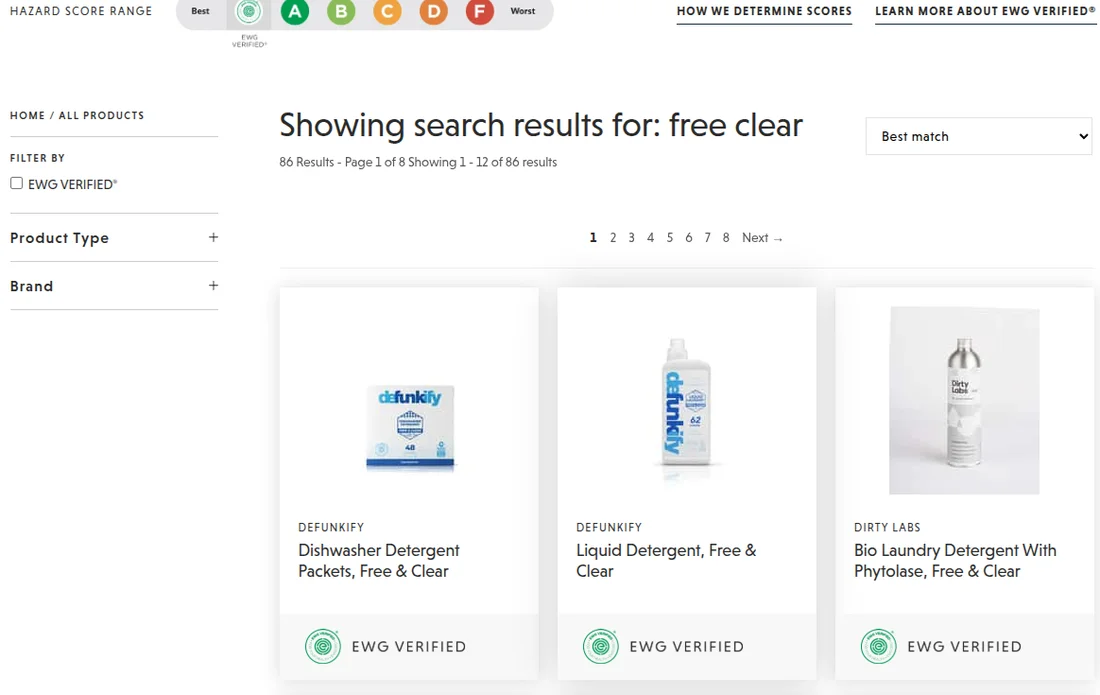
One small label study looked at a different phrase, “free and gentle,” on laundry products.
Laundry products labeled 'free and gentle' genuinely excluded fragrance (0% contained it across every product category), but still commonly contained preservative allergens (MI in 57.1% of free-and-gentle detergents) and surfactant allergens (decyl/lauryl glucoside in 28.6-33.3% of free-and-gentle detergents and stain removers). Moderate evidence. Bai 2020
Air fresheners can grade a B
We searched for Febreze. Every product on the first page of results was graded B. We opened a lavender air mist.
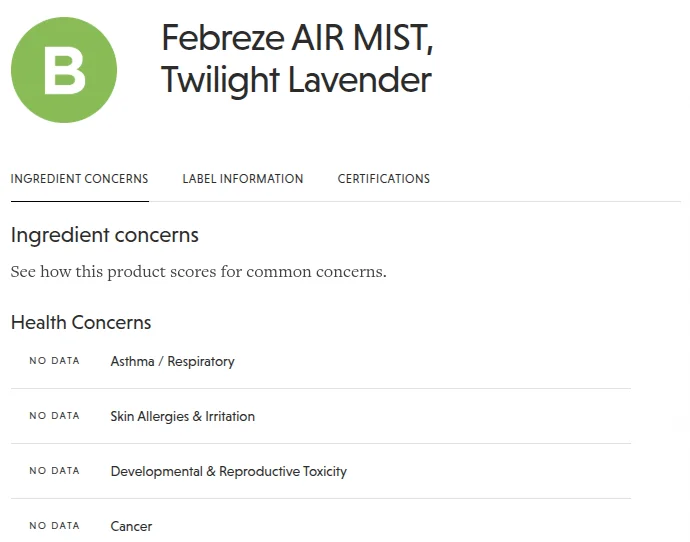
Under the B, every health concern, asthma and respiratory included, said “No data.” The ingredient section said “Ingredient disclosure: Some,” and fragrance was graded D.
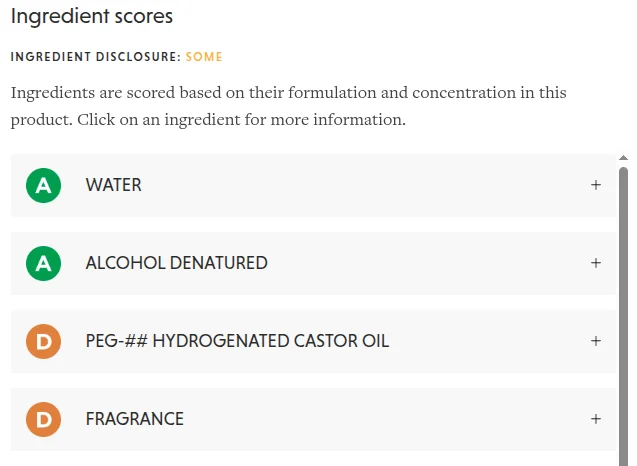
EWG says its cleaning ratings “do not account for the level of exposure,” and an air freshener exists to put its scent into the air you breathe. This page also marked disclosure as only “Some.” Incomplete labels matter.
In 2007, EPA and CPSC both denied citizen petitions (Sierra Club, National Center for Healthy Housing, Alliance for Healthy Homes, NRDC) asking for air freshener ingredient testing and labeling, and there is still no federal requirement that air fresheners disclose their ingredients on the label. Strong evidence. EPA 2007 (72 FR 72886)
When researchers tested 25 best-selling US laundry, cleaning, personal-care, and air-freshener products, they found 133 different chemicals released into the air, but only 1 of them was listed on any product label. Moderate evidence. Steinemann 2011
So a B for an air freshener doesn’t tell you it’s fine to spray around someone who reacts to scent. Our air freshener article has more on what they release.
How to use both if you’re avoiding fragrance
- Search with the words brands use: “fragrance free” on Skin Deep, “free clear” and “unscented” on the cleaning guide.
- Open the product before you trust the color. On Skin Deep, read the “Label information” tab. On the cleaning guide, read the ingredient list and the “Ingredient disclosure” line.
- Look for fragrance, parfum, aroma, essential oil, and anything “unspecified.”
- Check the “Data last updated” date, then compare the list with your package.
- Treat “EWG Verified” as a sign of disclosure, not a promise of no scent. Treat a Skin Deep score as a hazard flag, not a measure of how much of an ingredient is in the product.
- Paste any list into our label decoder for a second check.
- If you’re allergic to fragrance, ask your dermatologist about the allergen databases built for that. If you are allergic to fragrance, dermatologists advise avoiding all fragrance rather than only the chemicals you tested positive to, and choosing products from a checked database such as the ACDS CAMP list or SkinSAFE instead of trusting 'fragrance-free' claims. Moderate evidence. Rodriguez 2024
Why we still send you there
EWG’s sites are free and enormous, and they rate the ingredient “fragrance” as a high hazard. Searching them for fragrance-free products is faster than reading labels in a store aisle. The scores are a starting point. The ingredient list is the next check, even though labels can leave things out. That is the labels’ failing, not yours. You shouldn’t need a research project to buy soap.
One thing to know: EWG’s product pages have “Where to buy” links, and the pages say EWG may earn affiliate commission on purchases through them. We don’t.
What you can do
- Run any ingredient list through our label decoder before you buy.
- Tell the brands and stores you buy from that you want the whole ingredient list, including what is in the scent. Here’s how.
- Take the pledge to ask for fragrance-free air once this year.
Website details are from our own visit on October 4, 2026, and may have changed. Research findings show their evidence grade and source. Screenshots are of EWG’s websites, shown for review. Information, not medical advice.