An app that rates cosmetic ingredients gave a men’s eau de toilette 19.2 out of 20. INCI Beauty scores each product out of 20. We tested it as someone avoiding fragrance would, and it puts the one filter we needed behind an account or a paid plan.
Evidence key Strong Moderate Weak How we grade
Everything about the app below is what we saw on an Android phone on October 3, 2026, with the region set to the United States. Apps change, so check yours. We have no connection to INCI Beauty and earn nothing from it.
Before you see anything, an ad
When we opened the app, the first thing on screen was a full-screen video ad for another company’s app, with a Skip button. Only after closing it did we reach INCI Beauty itself. The app’s own menu offers Premium to “browse the app without any ads.”

The good news: we could browse without an account. Scan and Search were both on the home screen.
Search is a category browser
Tapping Search opened a list of categories, not a search box we could type a product name into. We had to drill down by category to find anything.

Inside Fragrance we found “Baby perfume” and “Perfume for kids.”

Fragrance in children’s products is common, and one baby perfume listed more named allergens than anything else in a large registry. About half of children's cosmetics in a Danish registry (634 of 1,179, 53.8%) listed perfume or a named fragrance allergen, and a US survey of 533 baby/child personal care products found a closely similar share (255/533, 47.8%; Bonchak 2018); in Danish baby-care products the commonest named allergens were linalool, limonene, and benzyl alcohol (the US primary does not report limonene or linalool by name). Strong evidence. Sukakul 2024 Industry-funded A perfume ('eau de cologne') marketed for babies listed 16 different fragrance allergens, the most of 1,179 children's products in a Danish registry. Strong evidence. Botvid 2023
A perfume scores 19.2 out of 20
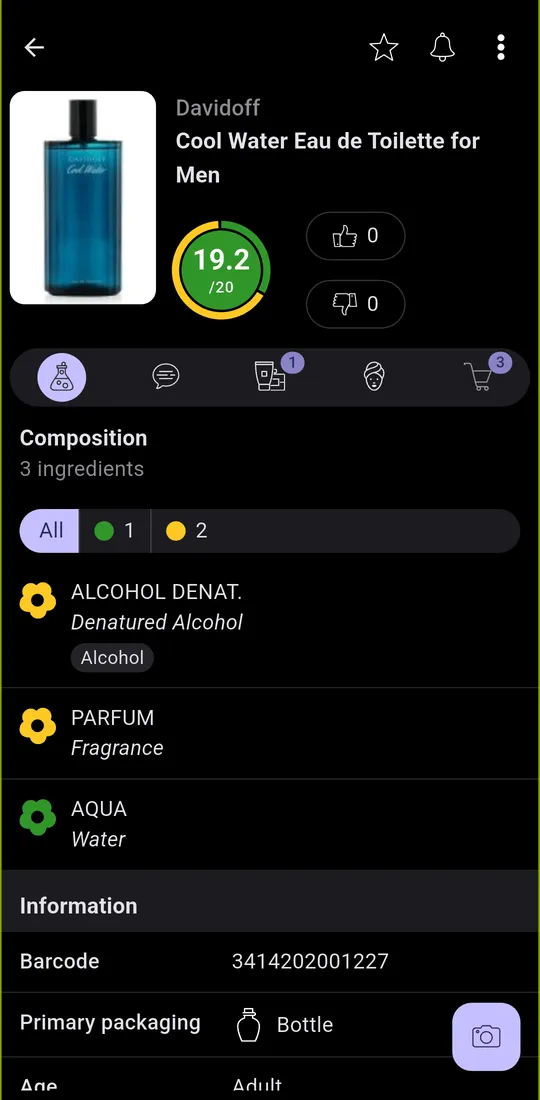
In men’s eau de toilette, the top results scored 19.9, 19.2, and 18 out of 20. One of them was Davidoff Cool Water at 19.2.

Cool Water’s page listed three ingredients: denatured alcohol, “PARFUM,” and water. The app gave “PARFUM” a yellow flower.
Tapping “PARFUM” explained the score. The app says the word can hide many scent molecules and that you may be allergic to one of them. Then it rates it “Low penalty.” Its own statistics on the same screen say “PARFUM” is in 65.78% of cosmetics, and in over 99% of the perfume categories it lists.

That’s the part we can’t get past. An app that admits one word can stand for an unknown mix of possible allergens shouldn’t then hand the product a near-perfect grade. In our view, a score that treats a perfume as 19.2 out of 20 is no help to anyone trying to keep fragrance out of their air or off their skin. And the industry’s own limits weren’t designed for people who are already allergic. The industry's fragrance safety-limit system (QRA/IFRA Standards) is explicitly designed to prevent new fragrance allergies from developing, not to protect people who are already allergic from reacting to a compliant product. Strong evidence. Api 2020 (RIFM/IFRA) Industry-funded
Leaving fragrance out costs you
We tried to exclude fragrance. The “Restrictions” button asked us to log in or create an account.

In Filters, “Excluded ingredients” and “Ingredients included” were both marked Premium.

The free Label filter offered organic and eco certifications. None of them was fragrance-free.

In our opinion, leaving out an ingredient the app itself calls potentially allergenic, and says is in 65.78% of cosmetics, shouldn’t require an account or a subscription. INCI Beauty put one way to do it behind a login and marked its ingredient filters Premium, while showing us a third-party ad before the app even loaded. To us, that puts paying customers first and people who react to fragrance last.
What it does well
- You can browse and read ingredient lists without an account.
- Each ingredient gets its own color flag and an explanation, so you can see “PARFUM” for yourself if you look past the score.
- The app is upfront, on the ingredient screen, that “fragrance” can hide many molecules.
We scanned a “fragrance-free” body wash
We scanned one bottle we had at home: Cetaphil Ultra Gentle Body Wash, labeled “Fragrance Free.” Its ingredient list includes heliotropine. The EU’s official cosmetic ingredient database, CosIng, lists “fragrance” and “perfuming” among heliotropine’s functions, and our label decoder flags the name for that reason. The label doesn’t say what heliotropine is there for, and a scan can’t tell you. We wanted to see whether each app would point it out.
When we reopened the app to scan, another full-screen ad played first, this time for a cryptocurrency exchange. The scanner then asked for our location, which it said was optional and anonymized; we declined. It stalled once (“taking too long to initialize”) and worked on the second try.
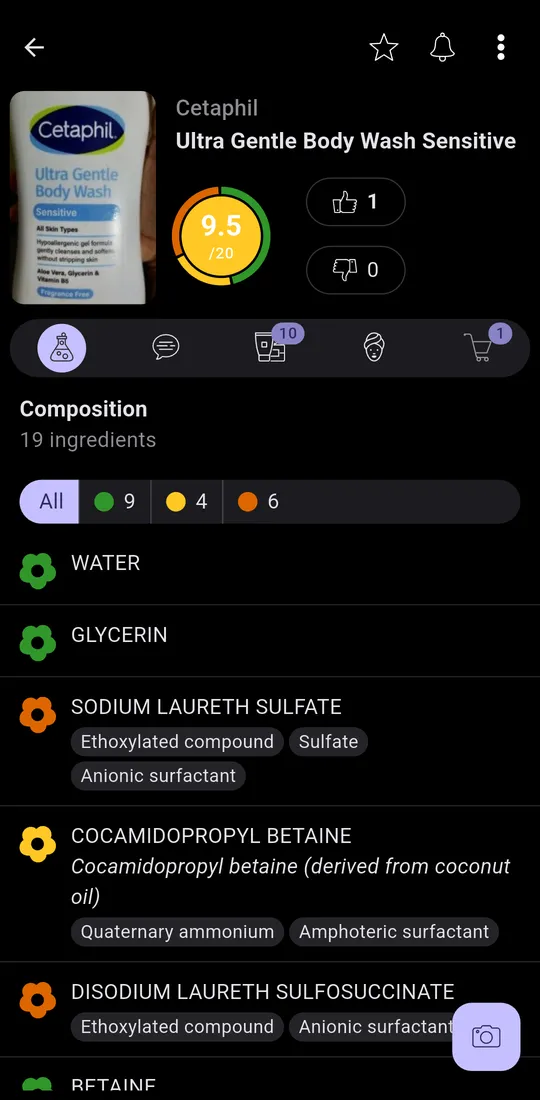
It rated the wash 9.5 out of 20, about half the 19.2 it gave Cool Water perfume.
Its own page for heliotropine lists “Fragrance agent” and “Masking agent” among the possible functions, and still gives it a green flower: “No penalty.”
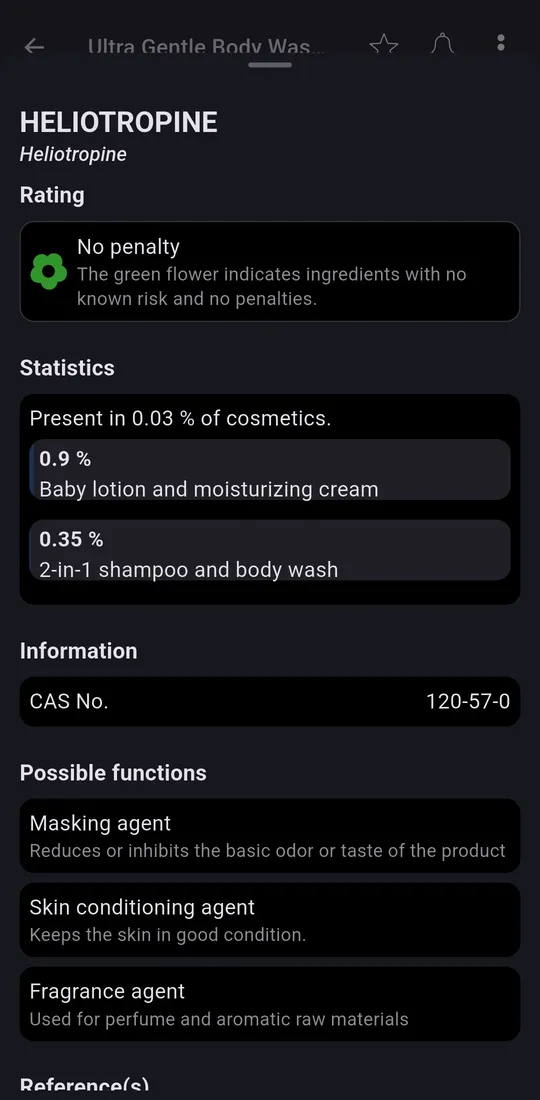
We think an app that knows an ingredient can be a fragrance, charges it nothing, and scores perfume above a wash sold as fragrance-free has its priorities backward.
A 2016 label survey of “fragrance free” body moisturizers found some listed ingredients that a dermatology allergen database flags for fragrance-allergic patients. That doesn’t prove added scent. In a 2016 survey of 174 best-selling US body moisturizers, 18 of the 40 labeled "fragrance free" (45%) still listed at least one ingredient that dermatologists' allergen database (ACDS CAMP) flags for fragrance-allergic patients. Moderate evidence. Xu 2017
How to use it for free if you’re avoiding fragrance
- Ignore the score out of 20. Open the ingredient list on every product.
- Look for “Parfum” or “Fragrance,” and for named scent chemicals like limonene and linalool.
- Limonene and linalool deserve extra attention once they’ve been exposed to air. Common fragrance chemicals such as limonene (citrus) and linalool (lavender) react with air to form far stronger skin allergens; in mouse tests, oxidized limonene was about 10 times more potent than fresh limonene. Strong evidence. Karlberg 2013
- For a second check, paste the ingredient list into our label decoder, or look up a chemical in the ingredient guide.
- If you’re allergic to fragrance, ask your dermatologist about the allergen databases built for that. If you are allergic to fragrance, dermatologists advise avoiding all fragrance rather than only the chemicals you tested positive to, and choosing products from a checked database such as the ACDS CAMP list or SkinSAFE instead of trusting 'fragrance-free' claims. Moderate evidence. Rodriguez 2024
- A score can’t tell you what a room smells like. If you want fragrance-free air at work or at school, ask for it with a printable sign or a letter.
We tested another popular scanner the same way. Read our EWG Healthy Living app review.
App details are from our own test on October 3, 2026, and may have changed. Research findings show their evidence grade and source. Screenshots are of INCI Beauty’s app, shown for review. Information, not medical advice.