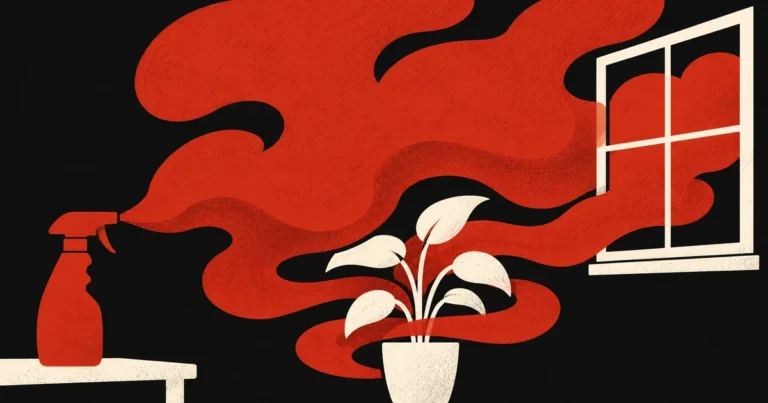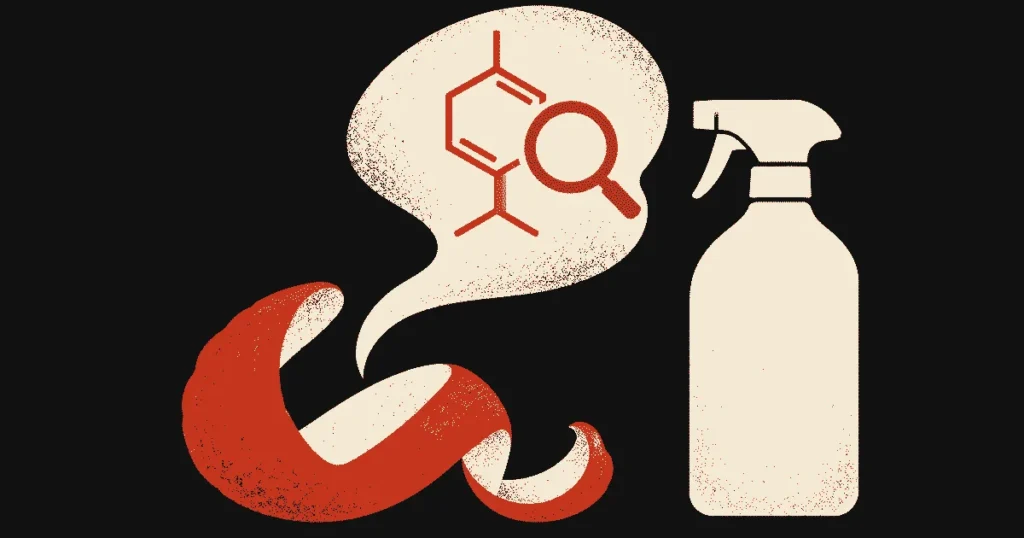
You wipe down the counter with the lemon spray, and the whole kitchen smells clean. Limonene is the citrus-scent chemical behind that smell. Is it safe? The research doesn’t hand us a flat yes or no, and we won’t invent one. It does show what changes the picture: whether the chemical has been exposed to air, and what the air around it is doing.
Evidence key Strong Moderate Weak How we grade
Fresh limonene and oxidized limonene are different
“Is it safe?” hides a second question: safe when? Fresh out of the bottle, or after it has met the air?
Scent chemicals such as limonene and linalool rarely cause skin allergy when fresh, but once exposed to air they form much stronger allergens; products and oils kept open or stored a long time can contain more of them. Strong evidence. Karlberg & Lepoittevin 2021
Common fragrance chemicals such as limonene (citrus) and linalool (lavender) react with air to form far stronger skin allergens; in mouse tests, oxidized limonene was about 10 times more potent than fresh limonene. Strong evidence. Karlberg 2013
Why the usual allergy test misses it
The standard test checks the fresh version. The allergy in these patients is to the oxidized one.
Standard fragrance allergy screening tests (the fragrance mixes, HICC, Myroxylon pereirae, colophonium) missed about 70% of patients allergic to oxidized limonene or linalool; only 30-33% of hydroperoxide-allergic patients also reacted to any standard baseline marker. Strong evidence. Deza 2016 Industry-funded
Standard allergy tests with fresh limonene and linalool miss most of these allergies, so European experts now recommend adding the oxidized forms to routine patch testing. Strong evidence. Ogueta 2022
Children’s products raise the same problem.
The two commonest fragrance allergens on Danish children's cosmetics, limonene (22% of fragranced products) and linalool (18%), are not in the standard European patch test series; they become strong allergens when they oxidize in air. Moderate evidence. Botvid 2023
Then there’s the law. Read the caveat on this one carefully.
EU law now states, as a general principle, that fragrance substances able to transform into known contact allergens via air oxidation or bioactivation ('prehaptens and prohaptens') should be regulated the same as the allergens they become — but this 2023 amendment does not apply a specific hydroperoxide limit or peroxide-value restriction to limonene or linalool, the two chemicals most discussed in the oxidized-fragrance-allergen literature. Moderate evidence. Regulation (EU) 2023/1545
Reaction rates among dermatitis patients
The numbers in the first three cards here come from people sent to a skin clinic for a rash, not from the general public.
In European skin clinics, 2.8-5.2% of patients tested for dermatitis reacted to oxidized limonene. Strong evidence. Karlberg 2013
In patch tests of 2,900 dermatitis patients in six countries, 5.2% were allergic to oxidized limonene and 6.9% to oxidized linalool, two of the most common fragrance chemicals. Strong evidence. Bråred Christensson 2016 Industry-funded
Among 5,773 people tested for eczema at a Swedish hospital, 9.4% were allergic to the air-oxidized forms of two of the most widely used scent chemicals: linalool (7.0%) and limonene (5.1%). Strong evidence. Sukakul 2022
A controlled study shows how quickly it can go once someone is allergic.
In a controlled study, everyone already allergic to limonene hydroperoxides (11/11) developed a skin reaction within about a week of daily exposure to fine-fragrance-level doses of oxidized limonene (140 ppm and up); healthy people (0/17) had no reaction even at the highest dose tested. Strong evidence. Bennike 2019
In the air at home
Limonene is not a rare chemical. Check how common it is in homes.
In EPA's large 1980s studies of US homes, limonene, the chemical behind lemon scents, was the airborne chemical with the highest average concentration in people's homes. Strong evidence. Wallace 1991
Limonene was the most prevalent and highest-concentration of 88 volatile organic compounds measured in a national survey of Canadian homes: detected in 99% of homes, with an arithmetic mean of about 45 ppb (roughly 250 ug/m3) and a geometric mean of about 25 ppb (roughly 140 ug/m3), levels well above limonene concentrations reported in Australian, European, and Californian indoor-air studies. Strong evidence. Dales & Cakmak 2019 Industry-funded
Indoors, limonene can react with ozone.
Scent chemicals such as limonene and pine oil react with ozone indoors to make new pollutants, including formaldehyde and fine particles, that keep forming for hours after cleaning ends. Strong evidence. Nazaroff & Weschler 2004
In a real test house, using a limonene-scented foam cleaner exactly as the label directed produced a burst of 45,000-150,000 tiny new particles per cubic centimeter within minutes, but only when ozone was in the air. Strong evidence. Rossignol 2013
Don't run ozone-generating air purifiers while using scented cleaners: the particle burst from a limonene cleaner only happened when ozone was present, including from a commercial ozone-generating purifier. Moderate evidence. Rossignol 2013
Natural doesn’t change the chemistry
“Natural” on a label is a selling point, not a safety claim.
Essential oils are made largely of the same chemicals labeled as fragrance allergens: supplier data sheets give sweet-orange oil about 95% limonene, lavender oil about 40% linalool, and palmarosa oil up to 84% geraniol. Moderate evidence. Klaschka 2016
What nobody has pinned down
Despite thousands of positive allergy-test reactions to oxidized limonene and linalool reported worldwide, the fragrance industry's own market-testing program concluded that where people are actually getting exposed to these allergens "remains elusive" — the industry itself has not identified the real-world consumer-product source of a widely documented skin allergy. Moderate evidence. Natsch 2019 Industry-funded
That is the industry’s own finding, and it cuts both ways. It doesn’t mean the allergy isn’t real. It means the industry itself says it hasn’t identified where the exposure is coming from. When the people who sell the scent can’t say where the exposure happens, you shouldn’t have to work it out alone.
What you can do
The graded claim below concerns recurring eczema and patch testing that includes oxidized limonene and oxidized linalool. Information, not medical advice.
If you have unexplained or recurring eczema, especially on the hands or face, ask your dermatologist about patch testing that includes oxidized limonene and oxidized linalool, not just the standard fragrance mixes; these two allergens alone accounted for 8% of positive reactions in one large clinic-referred study. Moderate evidence. Deza 2016 Industry-funded
One small study measured dryer-vent D-limonene after four households switched from fragranced to fragrance-free laundry detergent.
Switching from a fragranced to a fragrance-free laundry detergent cut the fragrance chemical D-limonene coming out of the dryer vent by up to 99.7% (mean 79.1%) within one month, in real households, with no extra cost or apparent inconvenience. Moderate evidence. Goodman 2019
- Look up limonene in our ingredient guide, and check labels with the label decoder.
- Where it comes from: scented cleaning and your air, scented laundry and dryer vents, air fresheners, and fragrance in cars.
- Why a label may not tell you: the fragrance loophole.
- Want it gone from the places you share? Start with the pledge and tell brands you want ingredients named at take action.
Every claim above shows its evidence grade and names its source. See all the limonene facts and the claims we won’t make. Information, not medical advice.