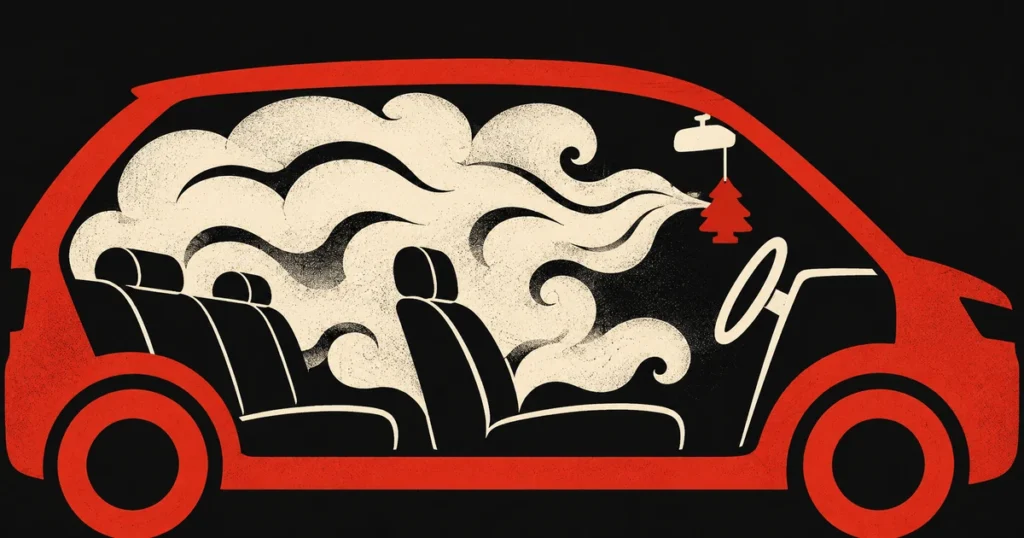
You get into a rideshare, the door shuts, and the little cardboard tree is already swinging from the mirror. A car is about the smallest room you’ll ever share, and you can’t step out of it at 60 miles an hour. Here’s what researchers have measured from car air fresheners, diffusers, and the products riders carry in with them, plus the one simple step that helped.
Evidence key Strong Moderate Weak How we grade
What the driver breathes
In a small study of real commutes, the air freshener changed what the driver breathed.
Keeping a gel air freshener in a car raised the fragrance chemical limonene in the air the driver breathed 3.6-4.7 times, to about 19-28 ug/m3, during real commutes (10 cars tested). Moderate evidence. Jo 2008
And what is it, exactly?
Plug-in and hanging car air fresheners mainly release fragrance terpenes (limonene, pinene, dihydromyrcenol) and fruity-smelling esters, the same terpenes found across larger product surveys. Moderate evidence. Pino-Delgado 2021; Steinemann 2011
In a one-car test, a new one gave off the most in its first few days.
A new Little Tree car air freshener releases most of its limonene in the first few days: in a closed car the limonene signal halved roughly every day and was nearly gone within 4-5 days. Moderate evidence. Pino-Delgado 2021 (J Student Res)
The chemicals the package never mentions
This was one product tested in a lab, not a measurement of what commuters breathe. It still shows what a label can’t.
A car air freshener's own terpenes (alpha-pinene, beta-pinene, p-cymene, limonene) react with in-vehicle ozone to form ultrafine particles and irritant gases (formaldehyde, acetaldehyde, acrolein) that never appear on the product's ingredient list, because they are made in the cabin air, not sold in the bottle. Moderate evidence. Lamorena & Lee 2008 (J Hazard Mater)
In a separate chamber study, two scent chemicals, limonene and alpha-pinene, drove nearly all of the ozone chemistry in a 23-chemical mixture.
Removing just the two fragrance terpenes (d-limonene and alpha-pinene) from the 23-chemical mixture, while keeping ozone and the other 21 chemicals, collapsed the secondary particle pollution to background levels (2-7 micrograms per cubic meter) and eliminated most of the irritant aldehydes — identifying these two terpenes as the drivers of essentially all the ozone-initiated chemistry in this mixture. Moderate evidence. Fan et al. 2003
Diffusers, and the rash that improved when one came out
In a small case series, an Uber driver and four Uber passengers developed facial and eyelid airborne contact dermatitis linked to fragrance diffusers used inside the cars; all five patients had positive patch tests to fragrance mix I and/or balsam of Peru, and the driver's dermatitis improved after he removed his own diffuser. Moderate evidence. Perper et al. 2017
Riders bring their own products in
It doesn’t take a tree on the mirror. Whatever comes into the car on the people in it counts too.
A personal-care product containing the silicone D5 (such as a deodorant applied hours earlier) can raise D5 levels inside a car far above outdoor background, and this passenger-carried D5 vents out of the car and mixes with the vehicle's exhaust-associated emissions when the cabin fan runs. Moderate evidence. Coggon 2018
Headaches and migraines
None of these was measured in a car.
In a US national survey, about 1 in 5 adults (20.4%) said air fresheners gave them health problems such as breathing difficulty, migraine, or asthma attacks. Moderate evidence. Steinemann 2017
About 1 in 8 adults (12.6%) in four countries said fragranced products trigger migraine headaches, and 7% said they trigger asthma attacks. Moderate evidence. Steinemann 2019
In a 3-hour chamber test at realistic ozone and citrus-terpene (limonene) levels, people with mild asthma rated the air as less irritating to their eyes, nose, and throat than healthy people did, but reported more chest tightness, headache, and flu-like symptoms. Moderate evidence. Fadeyi et al. 2015
11 of 12 women with MCS, and none of 12 controls, developed headache and nausea during a brain-scanning session simply from smelling ordinary odorants (vanillin, acetone, cedar oil, lavender oil, eugenol, butanol) at levels used for a routine imaging study. Moderate evidence. Hillert et al. 2007
What you can do
In the small commute study, the simplest step lowered the limonene.
Taking the air freshener out of the car removes its main added chemical: without one, in-car limonene was about 5-6 ug/m3. Moderate evidence. Jo 2008
- Take the tree off the mirror and the clip off the vent. If the car smells, clean it and air it out instead of covering it up.
- Skip car diffusers and scented sprays. More on why in essential oils and diffusers and air fresheners.
- In a taxi or rideshare, it’s fine to ask the driver to take the air freshener down or crack a window. Keep it about the product: “Would you mind taking the air freshener down? Scent gives me trouble.”
- If you drive for a living, a car without air fresheners or diffusers takes one avoidable scent source out of every ride. A printable sign can say it for you.
Every claim above shows its evidence grade and names its source. See all the car facts and the claims we won’t make. Information, not medical advice.