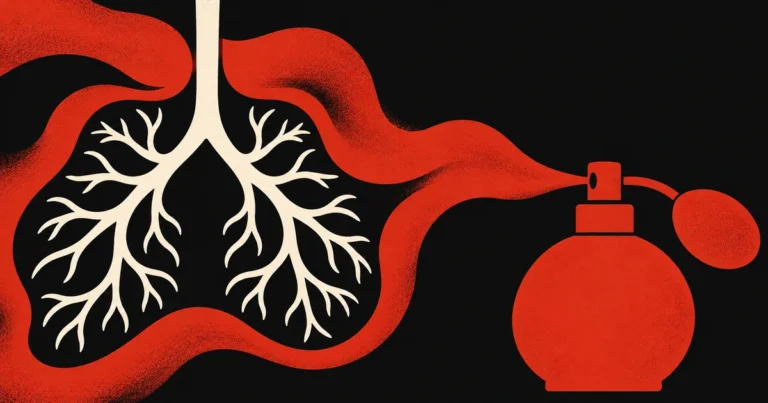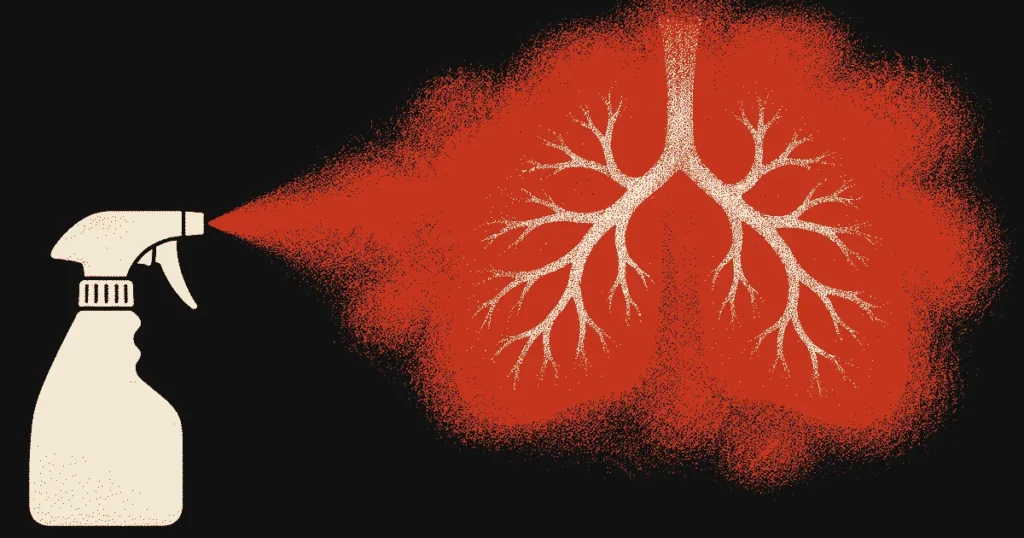
You spritz the counter, wipe it down, and the mist drifts up past your face on its way to somewhere else. Spray cleaners are sold as the quick, easy way to clean. Here’s what researchers have found when people clean with sprays and disinfectants, at home and on the job, and what to use instead.
Evidence key Strong Moderate Weak How we grade
In one big study, sprays stood out
A ten-country study followed adults who did the cleaning at home. People reported their own spray use and symptoms.
In a 10-country European cohort of 3,503 adults who did the cleaning at home and were asthma-free at baseline, using household cleaning sprays at least once a week was associated with a 49% higher rate of new asthma symptoms or asthma-medication use over about 9 years of follow-up. Moderate evidence. Zock et al. 2007
Using household cleaning sprays at least 4 days a week was linked to roughly double the rate of new physician-diagnosed asthma (HR 2.11, 95% CI 1.15-3.89) compared with light or no spray use, with a clear dose-response across frequency categories (P for trend 0.041) and number of different sprays used (P for trend 0.022). Moderate evidence. Zock et al. 2007
Products that weren’t sprays showed no significant link.
Cleaning products that were not applied as a spray (liquid multiuse cleaners, washing powders, polishes, bleach, ammonia, decalcifiers) showed no significant association with new-onset asthma in this study, while glass-cleaning, furniture, and air-refreshing sprays did. Moderate evidence. Zock et al. 2007
The link was about the same whether or not people had allergies. The claim reads that as pointing to irritation, not allergy.
The household-spray-asthma association was not modified by atopy (allergic sensitization): risk was similar in atopic (RR 1.30) and non-atopic (RR 1.33) participants, supporting an irritant rather than allergic mechanism. Moderate evidence. Zock et al. 2007
For what cleaning products have been linked to in babies, see fragrance and babies.
What cleaning puts into the air, in tests
Most of these are chamber measurements, not what every home reaches every day. They show what particular products did in particular tests.
Wiping a small kitchen table with a few grams of an ordinary spray cleaner put 270-2,300 ug/m3 of the solvent 2-butoxyethanol into the air of a room-sized test chamber for the next hour; four of five cleaners tested contained it. Moderate evidence. Singer 2006, Indoor Air
Cleaning with a pine-oil or citrus cleaner raised scent chemicals (limonene, terpinolene, alpha-terpineol) to about 1,000-6,000 ug/m3 for the first hour in a room-sized chamber, and some stayed elevated for many hours afterwards. Moderate evidence. Singer 2006, Indoor Air
One cleaner’s solvent outweighed its scent.
Scent was only part of what a scented cleaner released: its glycol-ether solvent reached about 1,100 ug/m3 in room air against 71 ug/m3 for limonene. Moderate evidence. Rossignol 2013
A limonene-scented foam cleaner released formaldehyde, an irritant and carcinogen, both directly and through reactions with ozone after use. Moderate evidence. Rossignol 2013
In one real room, mopping did this.
During mopping with a terpene cleaner, scent chemicals such as limonene and pinene peaked at 280-380 ppb in the room air. Moderate evidence. Rosales 2022
Mopping a room with a terpene-based (pine- or citrus-type) cleaner caused bursts of tiny new particles, about 100 times the particle count of outdoor air, as the scent chemicals reacted with ozone. Moderate evidence. Rosales 2022
In a lab test, even the dried residue still reacted.
A dried film of pine-oil cleaner or orange-oil degreaser, with its scent chemicals already evaporated away, still produced formaldehyde and a burst of new particles when later exposed to ozone. Moderate evidence. Destaillats 2006
More on what happens after you clean: what scented cleaning does to your air.
Disinfectants at home
One German cohort of young adults found this.
In a German cohort of 1,695 young adults (19-24) followed from childhood, frequent private use of household disinfectants (a composite of methods including hand-wash, machine, sponge, and spray disinfection) was associated with close to a threefold increase in the odds of newly developing asthma, compared with people who didn't use disinfectants (OR 2.79, 95% CI 1.14-6.83). Moderate evidence. Weinmann 2017
A 10-year follow-up in the same cohort was less clear.
In a 10-year longitudinal follow-up of a German young-adult cohort (SOLAR, n=1,143), only participants who persistently used multiple disinfectants and cleaning products (sprays, disinfectant sprays, and nonspray disinfection methods) weekly at two assessments 10 years apart showed an elevated point estimate for current asthma (OR 1.68) and current wheeze (OR 1.71) compared with no weekly use; neither reached statistical significance (95% CI 0.48-5.88 and 0.75-3.90). Weak evidence. Pacheco Da Silva 2025
In one study of childcare facilities, the authors pointed to bleach.
Nearly all (93%) of the DC childcare facilities studied used chlorine bleach to sanitize surfaces, and chloroform (a bleach byproduct classified by IARC as possibly carcinogenic to humans, Group 2B) was detected in 100% of air samples; the authors attribute it mainly to bleach use. Moderate evidence. Quirós-Alcalá 2016
And EPA doesn’t treat bleach as the default even for mold.
The US EPA states that using a biocide such as chlorine bleach is not recommended as a routine practice during mold cleanup, reserving it for specific circumstances such as when immunocompromised people are present; the described default method is scrubbing with ordinary detergent and water. Moderate evidence. US EPA, "A Brief Guide to Mold, Moisture and Your Home" (accessed 2026-09-28)
Cleaning and disinfecting on the job
Cleaning isn’t only a chore at home. For some people it’s the job.
Cleaning products were the suspected exposure in 236 of 1,915 (12%) confirmed work-related asthma cases across California, Massachusetts, Michigan, and New Jersey (1993-1997); in California, janitors and cleaners had roughly double the confirmed-case rate of all other occupations combined (4.3 vs 2.3 per 100,000 workers). Moderate evidence. Nazaroff & Weschler 2004
Take nurses who already have asthma.
In a cohort of 4,102 US nurses already diagnosed with asthma (Nurses' Health Study II), weekly use of disinfectants to clean medical instruments was associated with poorly controlled asthma (OR 1.37, 95% CI 1.05-1.79) and very poorly controlled asthma (OR 1.88, 95% CI 1.38-2.56) versus no weekly instrument disinfection, after adjusting for age, smoking, BMI, race and ethnicity. Moderate evidence. Dumas 2017
US nurses exposed to a combination of aldehydes (formaldehyde or glutaraldehyde) plus hypochlorite bleach/hydrogen peroxide plus enzymatic cleaners had the strongest asthma-control signal in the study: odds ratio 1.91 (95% CI 1.31-2.79) for very poorly controlled asthma versus nurses with low exposure to all seven disinfectant categories studied (P-trend=0.001). Moderate evidence. Dumas 2017
The study couldn’t separate one chemical from the mix.
In one French hospital study, the link showed up with one group of disinfectant chemicals.
Among 543 healthcare workers in 7 French hospitals/clinics, occupational exposure to quaternary ammonium compounds (QACs, e.g. benzalkonium chloride) was linked to about 7.5x higher odds of reported physician-diagnosed asthma (adjusted OR 7.56, 95% CI 1.84-31.05) and about 3.2x higher odds of nasal symptoms at work (adjusted OR 3.21, 95% CI 1.42-7.22), after adjustment for age, gender, smoking, BMI, and atopy. Moderate evidence. Gonzalez 2014
The single highest-risk activity for asthma and nasal symptoms was manual dilution of concentrated disinfectant products (adjusted OR 4.01, 95% CI 1.34-12.00 for asthma; 1.90, 95% CI 1.13-3.18 for nasal symptoms), higher than general disinfection or cleaning tasks alone. Moderate evidence. Gonzalez 2014
Self-report wasn’t enough to sort out who was exposed to what.
In a French study of 543 healthcare workers who used disinfectants, 99 (18.2%) could not be classified by exposure status from self-report alone, and researchers had to review Material Safety Data Sheets with 3 experts to determine which products contained quaternary ammonium compounds. Moderate evidence. Gonzalez 2014
In the US nurse study, that same group of chemicals showed no significant link to asthma control. We’re telling you that too.
Occupational exposure to quaternary ammonium compounds ('quats') and alcohol-based disinfectants showed no significant association with asthma control in a cohort of 4,102 US nurses (quats: OR 1.10, n=1,548 exposed, P-trend=0.14; alcohol: OR 1.11, n=1,591 exposed, P-trend=0.12), and the null for quats held in two further models adjusting for exposure to the other six disinfectant products. Moderate evidence. Dumas 2017
Their rights and the evidence at work are in fragrance at work.
“Green” and “natural” are claims, not proof
A label that says “all-natural” is making a marketing claim.
Green-claim auditors named 'all-natural' as a textbook example of a vague green claim and called household cleaning-product makers 'among the worst greenwash offenders'. Moderate evidence. Dahl 2010
Plant-derived scent chemicals drove the particle bursts, so a 'natural' citrus or pine scent is not automatically cleaner to breathe. Moderate evidence. Rosales 2022
A 2007 industry safety review left cleaners out
Here is one piece of the industry’s own safety paperwork, from 2007. Its caveat says what has changed since.
The fragrance industry's safety assessment of 17 salicylates counted exposure from 10 personal-care product types only. Household cleaners and detergents, which the same report lists as uses, and breathing fragrance in were not included. Moderate evidence. RIFM Expert Panel / Belsito 2007 Industry-funded
Most fragrance-free policies in one review leave out what the building itself buys.
Fewer than half (46.0%) of 63 reviewed fragrance-free policies included any supply-chain or procurement control over the cleaning, laundry, or air-freshening products the institution itself buys, even though named triggers in the companion focus-group study rank cleaning and laundry products alongside or above perfume. Moderate evidence. Roy et al. 2026 (scoping review)
What you can do
Start with the source, not the air purifier.
EPA's official framework for improving indoor air quality ranks three strategies in order: (1) source control (remove or reduce the pollutant source), (2) increased ventilation, and (3) air cleaners, which EPA says are far more effective for particles than for gaseous pollutants. Moderate evidence. US EPA, "The Inside Story"
Preferring non-spray (liquid or wipe-application) formats for glass cleaners, furniture polish, and air fresheners is a reasonable precaution, since these three spray product types had the clearest, statistically significant links to new-onset adult asthma in a large multinational cohort study. Moderate evidence. Zock et al. 2007
Take used paper towels, sponges, and mop water out of the room right after cleaning, ventilate during and after, and choose cleaners without 2-butoxyethanol (ethylene glycol monobutyl ether / butyl cellosolve on the label or SDS); avoid running ozone generators with terpene-scented products. Moderate evidence. Singer 2006, Indoor Air
Don't run ozone-generating air purifiers while using scented cleaners: the particle burst from a limonene cleaner only happened when ozone was present, including from a commercial ozone-generating purifier. Moderate evidence. Rossignol 2013
Never mix bleach with ammonia or acidic cleaners: it makes toxic chloramine or chlorine gas. Strong evidence. Salonen 2024
In the nurse study, the authors put getting rid of the hazard ahead of masks.
Only 5% of nurses in this study reported using a face mask or respirator when handling disinfectants, and use was more common among nurses with worse asthma control (likely because symptomatic nurses sought protection, not because protection failed); the authors explicitly recommend prioritizing elimination or substitution (e.g., non-chemical disinfection methods such as steam or UV light) over personal protective equipment as the more effective prevention strategy. Moderate evidence. Dumas 2017
- Put the spray bottles away. Pour a little cleaner onto a cloth instead, especially for glass cleaner, furniture polish, and air fresheners.
- Choose fragrance-free cleaners, and check ratings in EWG’s Guide to Healthy Cleaning. The shopping guide has more.
- Open a window while you clean and for a while after, and take used towels and mop water out of the room.
- Ask your workplace, school, or building which cleaning products it buys. A letter or a printable sign can do the asking for you.
- More in room by room and air fresheners.
Every claim above shows its evidence grade and names its source. See all the cleaning facts and the claims we won’t make. Information, not medical advice.