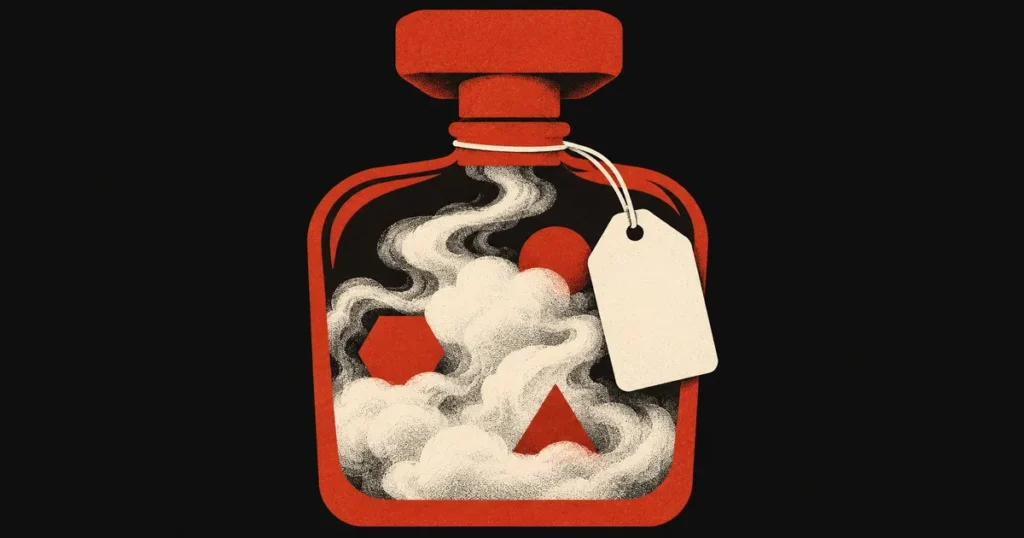
Turn over a bottle of perfume, or its box, and read the ingredient list. Somewhere in it is one word, “parfum,” standing in for the part that actually makes the scent. Perfume is sold as a feeling. On the label, most of the formula can hide behind that word. Here’s what researchers found when they looked past it, in product tests, allergy clinics, air-chemistry studies, and surveys.
Evidence key Strong Moderate Weak How we grade
One word stands in for most of the formula
Start with what the law lets a brand leave off the label.
In the EU, an entire perfume or fragrance composition can be declared on the ingredient list as the single word 'parfum' or 'aroma', legally hiding every chemical in it except the handful of allergens that must be named separately. Moderate evidence. Tegengif 2022
Europe does make brands name some allergens. Notice how short that list is next to everything else.
Since 2005 the EU has required cosmetic and detergent products to name 26 specific fragrance chemicals on the label if present above 10 ppm in leave-on products or 100 ppm in rinse-off products; every other fragrance ingredient can still be hidden under the single word "parfum" or "fragrance". Strong evidence. de Groot 2020, Dermatitis 31(1):13-35
Australia’s rules are looser still.
Under Australian law (cl. 7(8) of the Consumer Goods (Cosmetics) Information Standard 2020), a cosmetic product's fragrance can be listed on the label simply as "fragrance", "fragrances", "parfum" or "parfums", with no legal requirement to name the individual fragrance ingredients. Strong evidence. Consumer Goods (Cosmetics) Information Standard 2020 (Cth)
How much is behind that one word?
More than 2,000 chemical substances, of which 300 to 400 are of natural origin, are used across the fragrance industry, and a single perfume can contain from a few to several hundred individual fragrance materials. Moderate evidence. de Groot 2020, Dermatitis 31(1):13-35
What testing found behind the label
When researchers opened the bottle, here is what the label had left out.
The vapor from a single cologne contained at least twenty identifiable chemicals – limonene, linalool, linalyl acetate, alpha- and beta-pinene, terpinolene, citronellol, anethole, coumarin, diethyl phthalate among them – none of which appear on the label. Moderate evidence. Anderson & Anderson 1998
Lab tests commissioned by US campaigners found 38 chemicals not listed on the label of at least one of 17 popular perfumes; 10 of them had no toxicity study in PubMed. Moderate evidence. Sarantis et al. 2010 (Not So Sexy)
Even the part that is printed raises flags.
Auditing the printed ingredient lists of 20 popular perfumes sold in Belgium, Denmark, and the Netherlands against 13 official and NGO hazard lists (EDC lists, EU harmonized classifications, the SVHC candidate list, the EU fragrance-allergen list, environmental-persistence lists) turned up 26 problematic substances across the 20 products. Moderate evidence. Tegengif 2022
Six substances found in the tested perfumes are classed by this report as suspected endocrine disruptors: benzyl salicylate, BHT, butylphenyl methylpropional, ethylhexyl methoxycinnamate, ethylhexyl salicylate, and octocrylene. Moderate evidence. Tegengif 2022
Butylphenyl methylpropional, found in several of the tested perfumes, is the one substance in this report's list of 26 that is also classed as reprotoxic. Moderate evidence. Tegengif 2022
More on the solvent that carries the scent: fragrance and your hormones.
“Natural” perfume is still perfume
If “natural” on the bottle made you relax, check what this old analysis found.
In a 1996 Danish GC-MS analysis, 91% (20 of 22) of perfumes marketed as based on natural ingredients contained 1 to 7 of 11 well-known fragrance sensitizers at concentrations up to 7.7%, including one perfume with 6.04% hydroxycitronellal — above the concentration shown to sensitize 36% of healthy volunteers in patch testing. Moderate evidence. Rastogi 1996
Concentrations of hydroxycitronellal found in some 'natural' perfumes (up to 6.04%) exceeded the concentration shown to sensitize 36% of healthy volunteers in repeated-insult patch testing (5%), and were also well above the fragrance industry's own 1996 recommended maximum (equivalent to about 1% in the finished product). Moderate evidence. Rastogi 1996
One perfumer described what a natural ingredient can be for. Read the last part twice.
A perfumer writing in a chemistry journal said a natural ingredient such as rose oil is sometimes added in a "negligible quantity only to be able to say that you have rose oil in your formula", which "will please the marketing people" but does nothing for the scent. Moderate evidence. Ellena 2008 Industry-funded
Worn on skin, and a skin allergy risk
Dermatologists and the industry disagreed about how many people are allergic. Then somebody counted.
In 2000, EU cosmetics could declare an entire fragrance as the single word 'parfum'; the EU committee noted dermatologists' estimate that up to 2% of people have perfume allergy, against industry's claim that the true figure was 'far lower'. The EDEN population-based patch-test study (Diepgen 2015; n=3,119 patch-tested across 5 European countries) directly confirmed the dermatologists' estimate: 1.9% (95% CI 1.5-2.5) clinically relevant fragrance contact allergy, and 1.8-2.6% for fragrance mix I alone. Strong evidence. SCCNFP 2000
How concentrated a product sits on the skin matters.
Fine fragrances (perfume, cologne) carry more contact-allergy risk per use than the same allergen amount spread over a larger, more dilute area, because sensitization risk depends on allergen dose per unit skin area, not total allergen delivered. Moderate evidence. Johansen 2003, Am J Clin Dermatol 4(11):789-798
Deodorants were significantly more likely to be the reported cause of fragrance allergy in men than women (37.9% vs 21.1% of listed products, odds ratio 2.3), while scented lotion (odds ratio 2.6) and fine fragrances (odds ratio 4.2) were significantly more often the reported cause in women; shampoo showed no sex difference. Strong evidence. Heisterberg 2011
In a six-person trial of people already allergic, product-strength amounts were enough.
For people already allergic to oxidized linalool (the air-exposed form of a common floral fragrance chemical), using a scented cream or perfume containing it at concentrations similar to real products (as low as 0.3% oxidized linalool, 0.056% linalool hydroperoxides) was enough to trigger eczema within three weeks of twice-daily use in a repeated-use trial. Strong evidence. Andersch Björkman 2014
And the standard allergy test can miss it.
The standard fragrance patch-test screen (fragrance mix I, fragrance mix II, balsam of Peru) misses a large share of true fragrance allergy: this review's own cited figures range from about 40% to 70% missed depending on the comparison, and "approximately half" of relevant reactions to perfumes, deodorants, and shaving lotions go undetected by baseline testing. Moderate evidence. de Groot 2020, Dermatitis 31(1):13-35
In a 4-year German patch-test study of 1,468 patients tested with their own deodorants and perfumes, 129 had positive reactions to a specific product, and 58 of them (45%) were missed by the standard fragrance-mix, balsam-of-Peru, and lyral patch tests. Moderate evidence. Martini 2020
Most of it ends up in the air
Here is one perfume, measured in a 2024 test.
Almost everything in a perfume ends up in the air: one perfume released 964 mg of vapor per gram used, mostly alcohol but also about 32 mg per gram of terpene fragrance chemicals. Moderate evidence. Wu 2024
Then the scent keeps reacting.
Scent chemicals released by perfumes and scented products can react with ozone in indoor air to form new pollutants, including formaldehyde and fine particles. Strong evidence. Alblooshi 2025
Add it up across a city.
Perfumes and colognes alone released about 2.5 metric tons of organic gases a day into Los Angeles air in 2005, not counting fragrance in cleaners, air fresheners, or hair spray. Moderate evidence. Chen & Luo 2012
A top trigger for sensitive people
Among people with chemical sensitivities, perfume ranks with pesticides.
In a small (n=69) follow-up of Atlanta-area adults with chemical hypersensitivity, the products most commonly reported to trigger symptoms were cleaning agents (88.4%), pesticides (81.2%) and perfume (81.2%), followed by tobacco smoke (82.6%) and car exhaust (72.5%). Moderate evidence. Caress & Steinemann 2003 (EHP)
In small lab studies, it didn’t even have to be smelled.
In a small lab test where patients could not smell it, perfume released near their eyes caused more eye irritation than a saline dummy (1.1 vs 0.2 on a 0-3 scale); a later double-blind study found the same eye effect. Moderate evidence. Millqvist 1999
One nine-patient test tried a mask.
Wearing a mask with an active-carbon filter, the kind designed to remove odors and organic vapors from the air, did not stop a scent-triggered breathing reaction to perfume: symptom scores with the carbon filter were no different from a dummy filter. Moderate evidence. Millqvist & Löwhagen 1996
The industry measures its own customers
Who wrote the numbers on how much people use? Check the author list.
The cosmetics and fragrance industry generated its own dataset for how much perfume, hairspray, foundation, shampoo, body wash, and antiperspirant people actually use, written by staff of the cosmetics trade association (CTFA), the fragrance industry's safety institute (RIFM), and personal-care manufacturers including P&G, Unilever, Avon, Johnson & Johnson, Mary Kay, L'Oreal, Dial, and Takasago. Moderate evidence. Loretz 2006 Industry-funded
A single spray of perfume puts about a quarter gram of product on the skin (median 0.23 g per application), and a single hairspray application puts on about two grams from an aerosol can or three-and-a-half grams from a pump, based on a two-week diary-and-weighed-container study of regular users. Moderate evidence. Loretz 2006 Industry-funded
In the industry’s own model of vanillin exposure, perfume ranked near the top.
In this industry model, the highest simulated exposure to vanillin came from body lotion (prestige range, P95 8.79 mg/kg bw/day), eau de parfum (8.34) and eau de toilette (6.34), while plug-in air freshener and scented candles — despite having the highest simulated in-product concentrations of vanillin — produced comparatively low exposure (P95 1.81 and 0.81 mg/kg bw/day) because there is no direct skin contact and the modeled inhalation fraction is low. Moderate evidence. Safford 2017 Industry-funded
Smelling nice isn’t the same as clean
More than a third of Germans (37.8%) think people who wear perfume are more hygiene-conscious; fragrance can mask a smell but does not clean. Moderate evidence. Klaschka 2020
What you can do
You don’t have to put up with it, and you don’t have to wear it.
- Skip it. Clean skin and clean clothes don’t need a top note.
- If you react to perfume, ask your dermatologist about patch testing with your own products, not just the standard series.
- Check what else you put on your skin with our label decoder and EWG Skin Deep.
- Ask for fragrance-free air at work, in clinics, and in shared spaces. A printable sign or a letter does the asking for you.
More on where perfume goes once it’s on: perfume in your blood and why “natural” isn’t allergen-free.
Every claim above shows its evidence grade and names its source. See all the perfume facts and the claims we won’t make. Information, not medical advice.