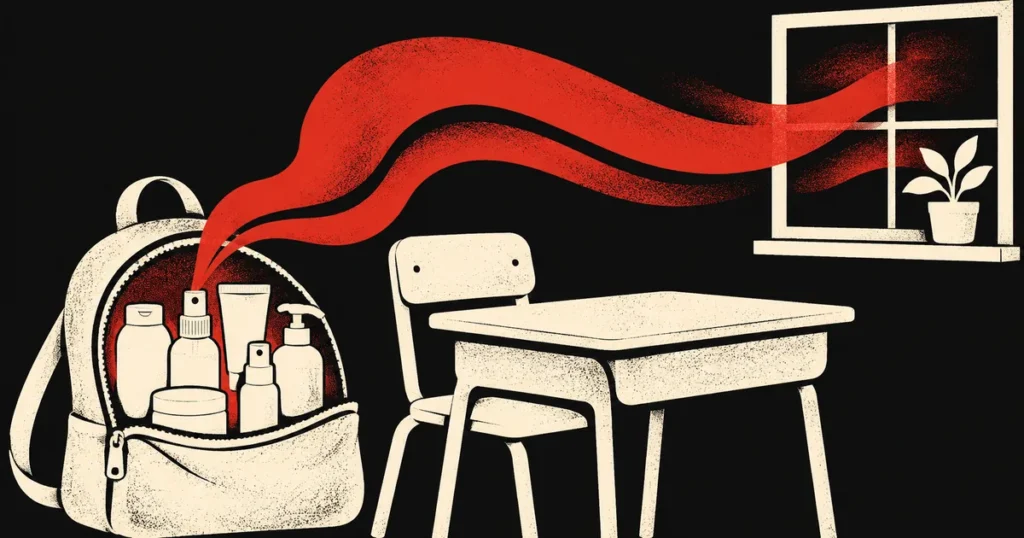
Walk down the kids’ aisle at a drugstore, or into a school on mopping day, and notice what you smell. Kids don’t choose the cleaner on their classroom floor, and they don’t control what goes into the body spray and play makeup sold to them. Here’s what researchers have found about fragrance in the lives of school-age kids and teenagers, and what you can ask for.
Evidence key Strong Moderate Weak How we grade
What’s in the products sold for kids
Start with the label tallies from a Danish registry of products marketed for children.
In a Danish registry of 1,179 cosmetics marketed for children, more than half (634, 53.8%) listed perfume or a named fragrance allergen, and nearly half (550, 46.6%) named at least one of the 26 EU-listed fragrance allergens. Moderate evidence. Botvid 2023
Even the lip balm.
93% of children's facial-care products in a Danish registry (80 of 86, almost all lip balms) listed fragrance, averaging nearly two named fragrance allergens each. Moderate evidence. Botvid 2023
Counting the word on the label probably misses some.
Counting the word "parfum" undercounts scented children's products, because essential oils and individual fragrance chemicals are listed under other names. Moderate evidence. Uber 2024
One small European test is the exception worth noting. There, the allergens clustered in the perfume-type products.
Everyday children's shampoos, shower gels, creams, and lotions rarely contained fragrance-mix allergens, cinnamic alcohol, cinnamic aldehyde, and isoeugenol were absent from every sample tested, while the notable allergen exposure was concentrated in perfume-type products and one toy. Moderate evidence. Rastogi 1999
And price may be a clue.
Cheaper baby and children's personal care products contain significantly more contact allergens than pricier ones: products with two or more screened allergens averaged $1.39 per ounce versus $4.35 per ounce for products with none. Moderate evidence. Bonchak 2018
It starts early
Parents, not kids, answered this survey, and it is graded weak. It is still worth knowing how young the habit starts.
In a US survey, parents reported that 7 in 10 children aged 12 and under (219 of 312) had used makeup or body products such as face paint, glitter, nail polish, or body spray, including more than half of children aged 3 or younger (48 of 84). Weak evidence. Medley 2023
Boys and girls alike.
In a US survey, boys and girls who used makeup or body products used fragrance products (perfume, cologne, body spray) at the same rate, about 31%. Weak evidence. Medley 2023
Most US children who use makeup also use products made for adults: only about a third (36%) used mostly children's products. Weak evidence. Medley 2023
In one Brazilian hospital survey, perfume was the norm.
In a Brazilian hospital survey, caregivers said two in three children aged 14 and under (182 of 276, median age 4) wore perfume. Moderate evidence. Melo 2020
Classroom air
Kids breathe whatever the adults chose to clean with. Start with how much limonene a classroom holds compared with the outdoors.
Limonene was 13x higher indoors than outdoors in European offices and classrooms, one of the two highest indoor/outdoor ratios of 23 chemicals measured. Strong evidence. Geiss 2011
Mopping day can change the air.
In a real working primary school, mopping a classroom with a limonene-containing detergent produced bursts of tens of thousands of tiny new particles per cubic centimeter within minutes, but only when ozone was present in the air; a plain water-only mop produced no such burst. Moderate evidence. Morawska 2009
For VOCs, the US has no federal limit indoors.
There are no federally enforceable US standards for volatile organic compounds in homes, schools, or other non-industrial indoor settings. Strong evidence. US EPA 2026
And kids are mostly missing from the research behind the limits that do exist.
Indoor irritant limits are built on studies of healthy young adults; a 2024 toxicology review found only one controlled irritation study in children (none under age 5) and concluded no evidence-based safety factor for children could be set. Strong evidence. Kleinbeck & Wolkoff 2024 Industry-funded
Even the toxicologists who set these limits suggest stricter, setting-specific limits where people breathe through the mouth during exercise, such as sports halls, playgrounds, and schoolyards. Moderate evidence. Kleinbeck & Wolkoff 2024 Industry-funded
What teens carry, and what a label can’t promise
In one study, teenage girls swapped several of their products for three days.
The phthalate most linked to fragrance (diethyl phthalate) fell by 27% in 3 days when girls avoided products listing fragrance unless labeled phthalate-free. Moderate evidence. Harley 2016
The same study found the catch. A label is not a guarantee.
Labels are not a guarantee: ethyl and butyl paraben actually rose after girls switched to paraben-free-labeled products, probably because some replacements contained them. Moderate evidence. Harley 2016
German testing has found traces of one fragrance ingredient in kids’ urine.
Lilial's metabolites have been measured, at very low concentrations, in the urine of children and adolescents in Germany (geometric mean about 10.2 µg/L for p-tert-butylbenzoic acid, about 1.5 µg/L for lysmeral, and below quantification limits for lysmerylic acid and hydroxy-lysmerylic acid). Weak evidence. Jablonská 2023, Sci Rep 13:18536
Fragrance allergy doesn’t wait for adulthood
Fragrance contact allergy is not rare in children: in a study of 1200 Danish school children aged 12-16, 1.6% of girls and 2.1% of boys tested positive to the fragrance mix, and one in three of them already had clinical symptoms. Moderate evidence. Johansen 2003, Am J Clin Dermatol 4(11):789-798
More in our fragrance allergy guide.
What teen studies found, and didn’t
One Swedish survey asked teenagers about sensitivity to chemicals in general.
Teenage girls reported chemical sensitivity about twice as often as boys (20.6% vs 9.9%), and being female, being sensitive to noise, or having probable anxiety each roughly doubled the odds of reporting it. Moderate evidence. Andersson 2008
Not every study finds a link between household cleaning and teens’ breathing, and this one didn’t. A fair page shows the results that don’t fit too.
In a Dutch birth cohort of 2,333 adolescents (age 14), a composite score for household use of 10 types of cleaning agents was not associated with asthma, rhinitis, or eczema, even at the highest exposure quartile: adjusted OR (95% CI) 0.95 (0.56, 1.63) for asthma, 1.23 (0.83, 1.82) for rhinitis, and 0.95 (0.56, 1.63) for eczema, comparing highest to never/seldom use. Moderate evidence. Bukalasa et al. 2019
For pregnancy, babies, and younger children, see fragrance and babies.
Most industrial chemicals lacked child-safety data
This is about industrial chemicals in general, not fragrance in particular. It shows how much of the basic data is missing.
A 2006 Lancet review found that of roughly 3,000 US high-production-volume industrial chemicals, basic toxicity data were publicly unavailable for nearly half, and 80% had no information on developmental or pediatric toxicity at all. Moderate evidence. Grandjean & Landrigan 2006
What you can do
You don’t have to wait for the rules to catch up. Kids can’t ask for cleaner air themselves, so the asking falls to the adults around them.
- Skip kids’ perfume, body spray, and scented play makeup. Nobody needs them.
- Check kids’ products with our label decoder and EWG Skin Deep. “For kids” and “gentle” are marketing words, not a promise.
- Ask your child’s school to clean fragrance-free and keep air fresheners, plug-ins, and diffusers out of classrooms. Our letter builder writes the note for you.
- If a rash keeps coming back, ask a dermatologist about patch testing, and bring a list of every scented product your child uses.
- More for families: our guide for parents, fragrance where you don’t expect it, and essential oils and diffusers.
Every claim above shows its evidence grade and names its source. See all the children’s facts and the claims we won’t make. Information, not medical advice.