You look up a perfume in a product-rating app, and where the rating should be, there’s a padlock. Think Dirty rates products on a 0 to 10 “Dirty Meter.” We tested it for fragrance. Before it would let us search, it asked for our location, required us to accept all of its consent preferences, and asked us to make an account. Then it put a padlock on the ratings we cared about most.
Evidence key Strong Moderate Weak How we grade
Everything about the app below is what we saw on an Android phone on October 3, 2026. Apps change, so check yours. We have no connection to Think Dirty and earn nothing from it.
Location first, then accept everything, or no app
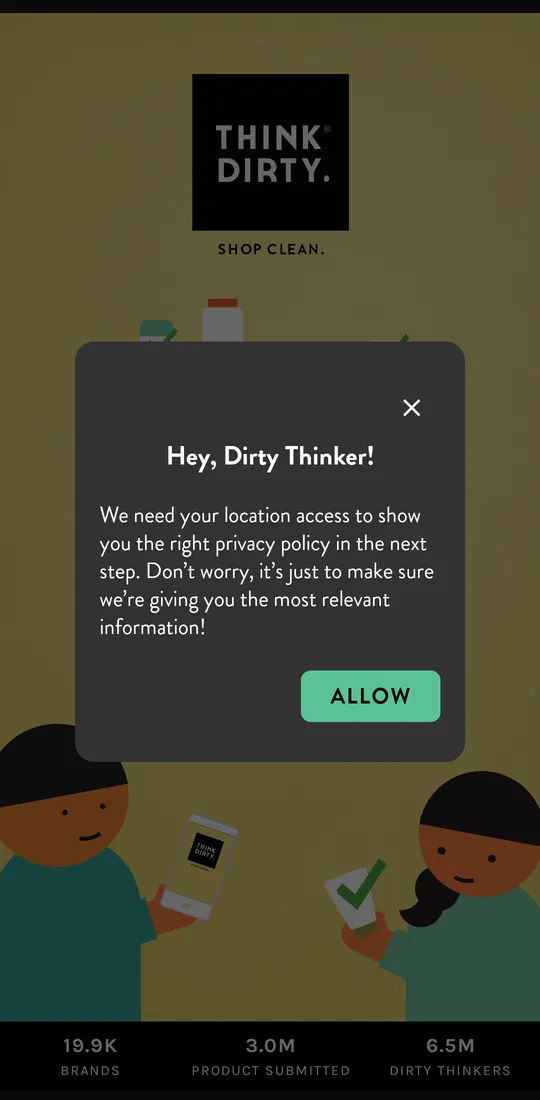
The first screen asked for location access, saying it needed it “to show you the right privacy policy.” We said no.
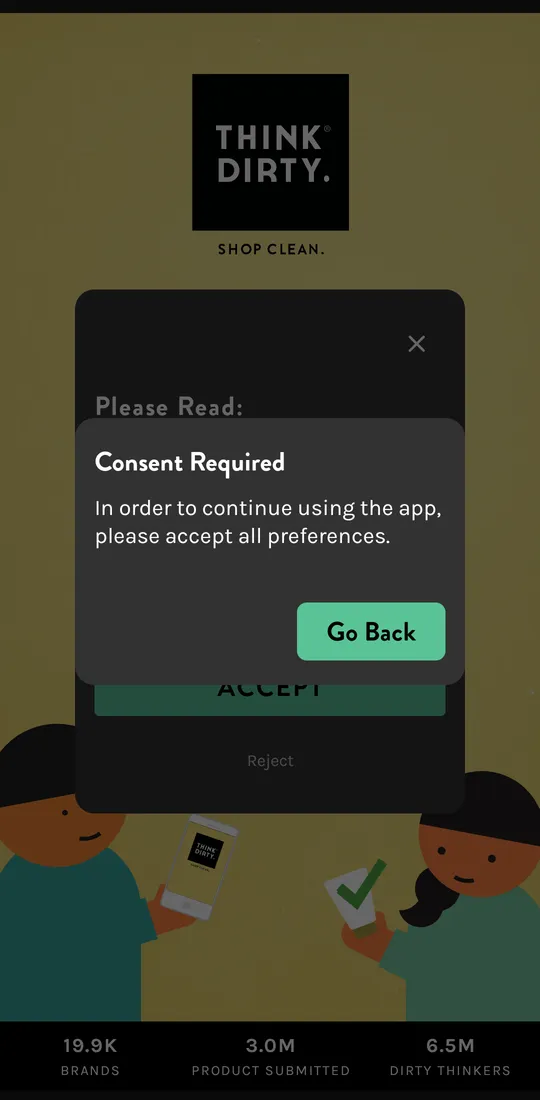
Next came a consent screen. We tapped Reject. The app answered, “In order to continue using the app, please accept all preferences,” and offered only a button back to the consent screen.
We think an app for checking ingredients should work for people who say no. This one didn’t.
Search and lists need an account
Even after accepting, search and lists asked us to sign up, with Google as the main option. When we set up the account, the app asked for a date of birth, gender, and phone number (all optional), then pushed a “Beauty Traits” quiz and a page of paid VIP features.

The quiz asked about skin type, skin tone, hair color, and eye color. It never asked whether we wanted to avoid fragrance.

“Recently Verified,” and sponsored
The home screen opens on a “Recently Verified” carousel. Right under that heading, it says “Sponsored.” One category, Women’s Deodorant, had a padlock on it.
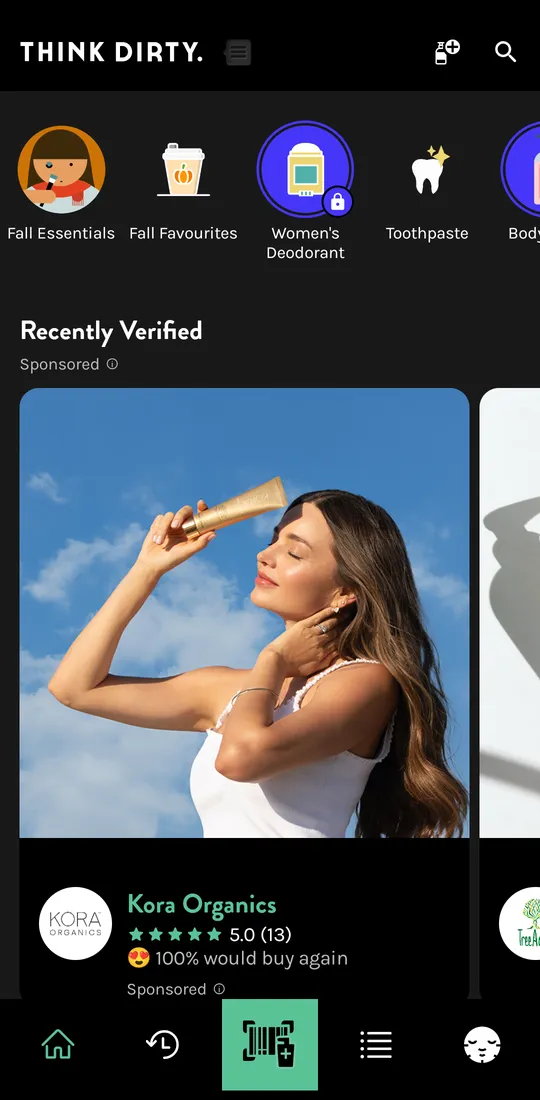
In our view, a sponsored placement shouldn’t sit under a heading like “Recently Verified.”
A scented plug-in, rated green
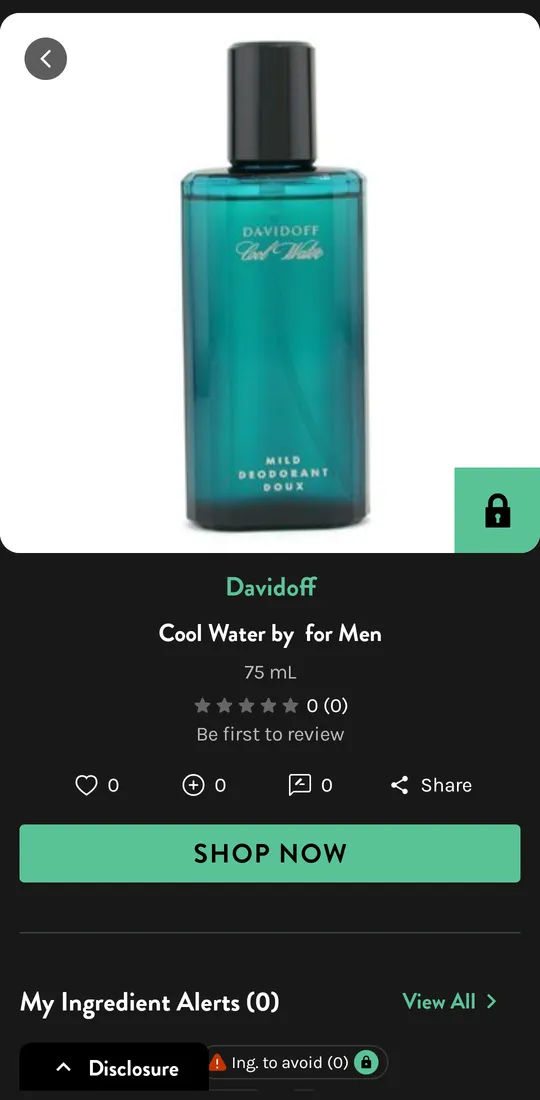
Searching “cool water” brought up Davidoff Cool Water, with its rating hidden behind a padlock. Right below it was a Glade PlugIns scented oil refill, rated 3 in green.

The Glade page was “User Submitted.” Its ingredient summary listed one ingredient, rated Clean. A note said the product “has not gone through official evaluation.”
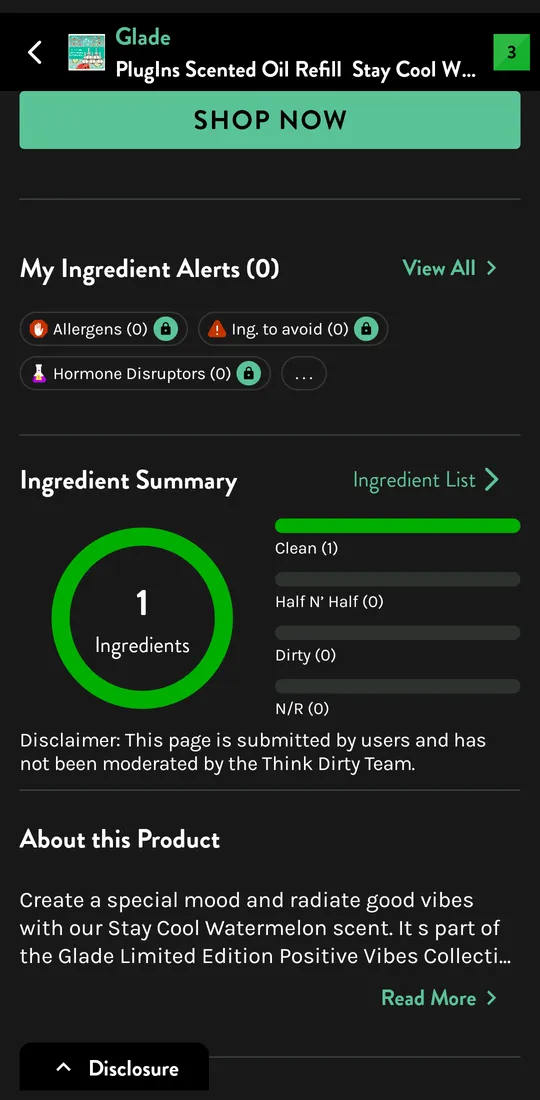

A green score built on a one-ingredient summary doesn’t show what this plug-in puts in the air. One small 2007 US test shows how little air freshener labels can say. In a 2007 NRDC lab test, none of 14 US air fresheners listed phthalates as an ingredient on the label, and 10 of the 14 listed no ingredients at all. Moderate evidence. NRDC 2007, Clearing the Air
Here’s what researchers measured in studies of individual plug-in products. The formaldehyde finding depended on ozone indoors. A plug-in scented-oil air freshener evaporated 1.5 g of product a day and kept its scent chemicals at 30-160 ug/m3 in the room over three days; its two largest emissions were fragrance esters (bornyl and benzyl acetate, 280-410 ug/m3), not the ozone-reactive terpenes usually studied. Moderate evidence. Singer 2006, Indoor Air Scent chemicals in cleaners and air fresheners react with ozone that drifts in from outdoors to make formaldehyde: cleaning raised formaldehyde by 9-16 ppb for 4 hours, and a plug-in air freshener raised it by about 6 ppb for as long as it ran. Moderate evidence. Singer 2006
The perfume’s rating is padlocked
We opened Cool Water itself. Where the rating should be, there’s a padlock.
A paid listing at the top of “fragrance free”
Searching “fragrance free” returned 1,431 results. The first ones shown were marked “Promoted.”

We think a search for fragrance-free products should lead with what fits, not with promoted listings.
Credit where it’s due: the only trash bag
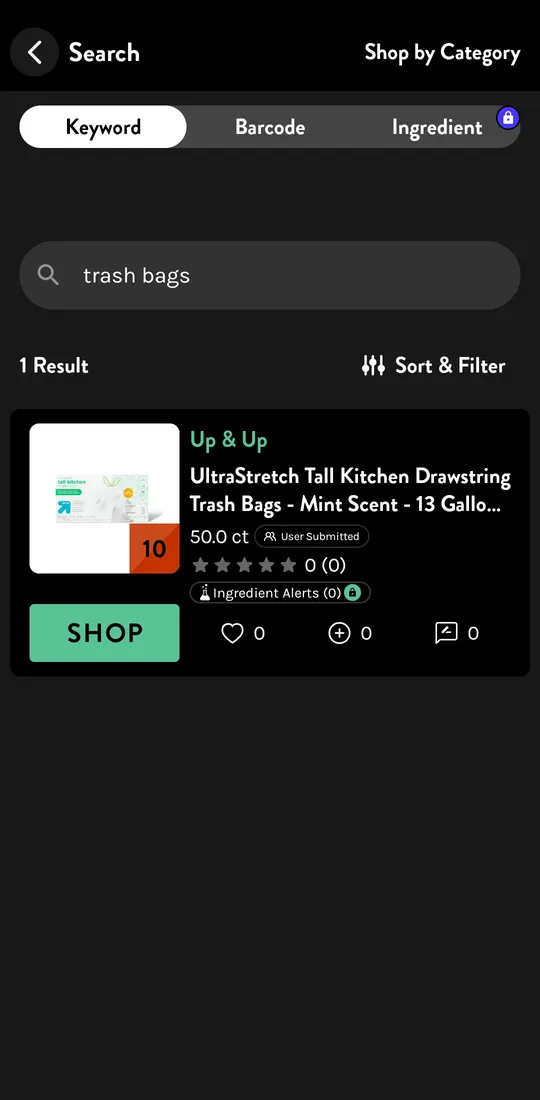
Of the apps we tested, Think Dirty was the only one where we found a trash bag. Searching “trash bags” found one: a mint-scented kitchen bag, rated 10, the top of its Dirty Meter.
The product was rated 10, and methyl salicylate, a chemical found in wintergreen oil, was the only listed ingredient also rated 10. Methyl salicylate (wintergreen oil) is a strong eye irritant in animal tests, causing irritation even at about 1%, and is toxic if swallowed; keep wintergreen oils and rubs away from children's eyes and mouths. Moderate evidence. RIFM Expert Panel / Belsito 2007 Industry-funded The bag’s other two listed ingredients, camphor oil and eucalyptus oil, were rated Clean.
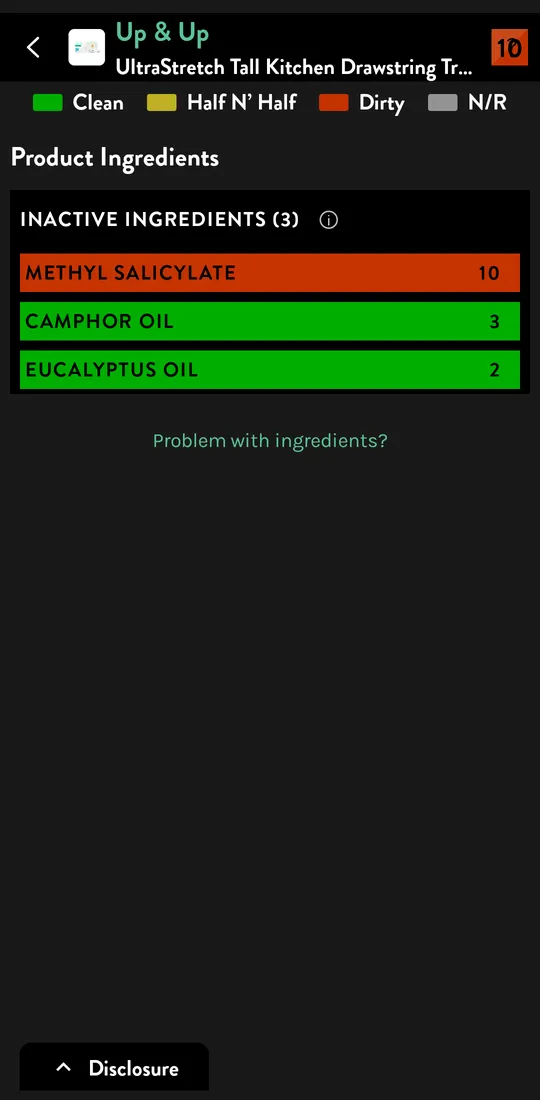
The app rated the two scent oils Clean. Its Ingredient Alerts for allergens, ingredients to avoid, and hormone disruptors all had padlocks on them.
What it costs
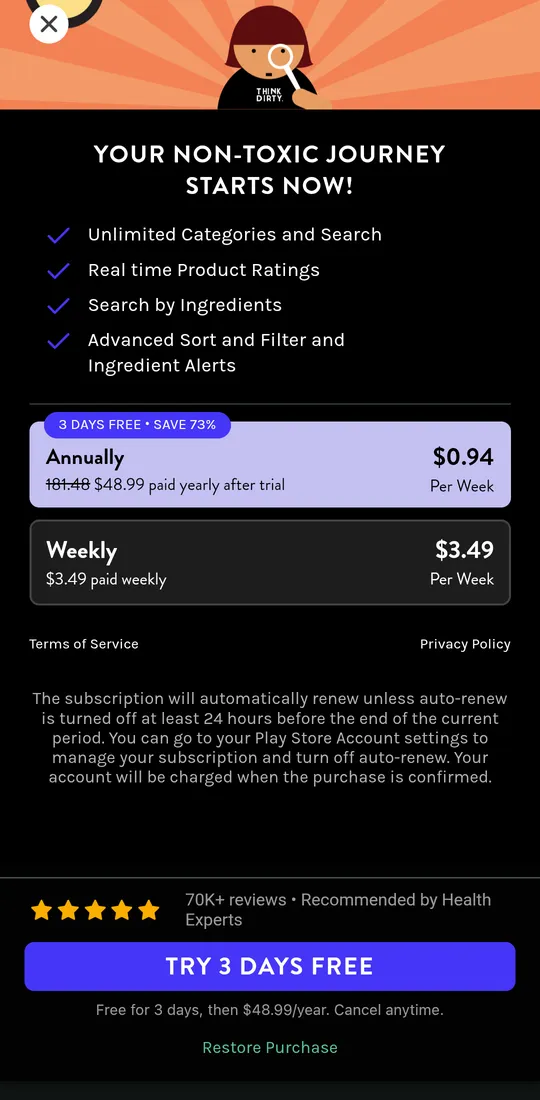
The VIP screen listed unlimited categories and search, search by ingredients, and ingredient alerts as paid features. It offered $3.49 paid weekly, or a 3-day free trial followed by $48.99 paid yearly.
Under US cosmetic labeling rules, fragrance ingredients can be grouped under the single word “Fragrance.” Under US regulations, fragrance and flavor ingredients in a cosmetic can be listed simply as "Fragrance" or "Flavor" on the label, because the Fair Packaging and Labeling Act cannot be used to force a company to disclose trade secrets, and fragrance/flavor formulas are the cosmetic components FDA itself identifies as most likely to qualify. Strong evidence. FDA 2026 (Fragrances in Cosmetics) That’s one reason ingredient-level alerts matter. We think charging weekly for them, while giving a scented plug-in a green score for free, gets the priorities backward.
We scanned a “fragrance-free” body wash
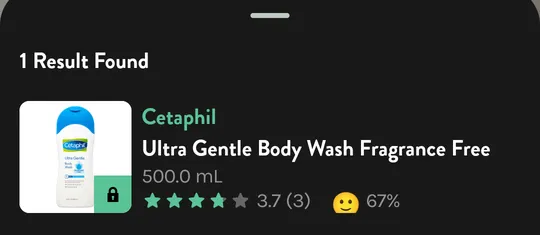
We scanned one bottle we had at home: Cetaphil Ultra Gentle Body Wash, labeled “Fragrance Free.” Its ingredient list includes heliotropine. The EU’s official cosmetic ingredient database, CosIng, lists “fragrance” and “perfuming” among heliotropine’s functions, and our label decoder flags the name for that reason. The label doesn’t say what heliotropine is there for, and a scan can’t tell you. We wanted to see whether each app would point it out.
Before showing a result, Think Dirty gave us a badge for our first scan.

Then it found the product, with the rating behind a padlock. The ingredient summary and every ingredient alert were padlocked too.
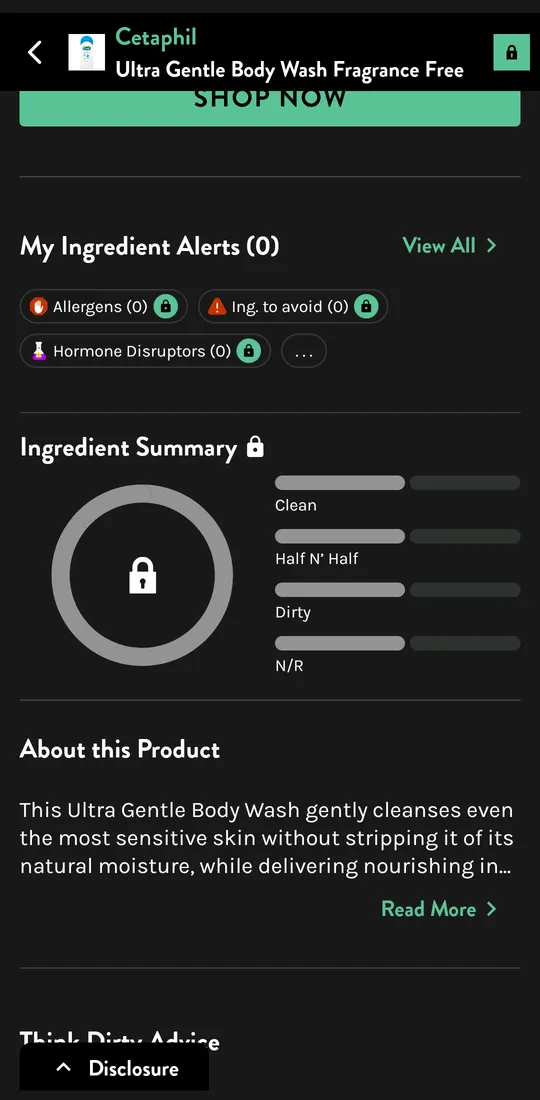
The badge was free. The rating wasn’t.
A 2016 label survey of “fragrance free” body moisturizers found some listed ingredients that a dermatology allergen database flags for fragrance-allergic patients. That doesn’t prove added scent. In a 2016 survey of 174 best-selling US body moisturizers, 18 of the 40 labeled "fragrance free" (45%) still listed at least one ingredient that dermatologists' allergen database (ACDS CAMP) flags for fragrance-allergic patients. Moderate evidence. Xu 2017
How to use it without paying
- Don’t trust a low score on its own. Open the ingredient list and look for fragrance, essential oils, and named scent chemicals.
- Treat “User Submitted” pages and one-ingredient summaries as unchecked.
- Skip the “Sponsored” and “Promoted” items when you’re searching for fragrance-free products.
- For anything without a full ingredient list, paste what you have into our label decoder.
- If you’re allergic to fragrance, ask your dermatologist about the allergen databases built for that. If you are allergic to fragrance, dermatologists advise avoiding all fragrance rather than only the chemicals you tested positive to, and choosing products from a checked database such as the ACDS CAMP list or SkinSAFE instead of trusting 'fragrance-free' claims. Moderate evidence. Rodriguez 2024
- Compare with our reviews of EWG’s app and others as we publish them.
- Asking for fragrance-free shouldn’t cost a subscription. Ask for it where you live and work with a printable sign or a letter.
App details are from our own test on October 3, 2026, and may have changed. Research findings show their evidence grade and source. Screenshots are of the Think Dirty app, shown for review. Information, not medical advice.