You say scent makes your eyes sting or your chest tighten, and the answer is “but you’re not allergic.” In selected eye and airway studies, standard allergy tests did not predict who reacted. Detergent, rosacea, and occupational studies also found irritant reactions that deserve to be taken seriously. Other clinic studies found substantial fragrance allergy, and none of this establishes the general split between allergy and irritation. Irritation is real, and it needs no allergy.
Evidence key Strong Moderate Weak How we grade
In selected eye and airway studies, allergy tests did not predict who reacted
Start with perfume itself.
The eye irritation from perfume vapor was not an allergy: people patch-test allergic to the very same perfume were no more likely to react than those who were not. Moderate evidence. Elberling 2006
The same research group looked at breathing symptoms.
Standard allergy tests did not predict who reacted to fragrance; people with sensitive airways (including non-allergic asthma) were 2-4 times more likely to react, pointing to airway irritation rather than classic allergy. Moderate evidence. Elberling 2005
Clinic patients showed the same thing.
Some people whose breathing problems are set off by scents do not have asthma or allergy: in a Swedish clinic study, 11 such patients had normal lung function, negative methacholine and allergy tests, and asthma medicines had given most of them little relief. Moderate evidence. Millqvist 1999
Another clinic study looked at coughing.
The extra coughing in multiple chemical sensitivity patients was not explained by asthma or classic allergy: patients tested negative on standard allergy skin-prick and methacholine airway-reactivity tests, and lung function (FEV1) did not change after capsaicin, pointing to an oversensitive airway nerve response rather than an allergic or asthmatic reaction. Moderate evidence. Ternesten-Hasséus 2002
Two studies outside fragrance found a similar pattern with irritant exposures, though neither is about scent.
The household-spray-asthma association was not modified by atopy (allergic sensitization): risk was similar in atopic (RR 1.30) and non-atopic (RR 1.33) participants, supporting an irritant rather than allergic mechanism. Moderate evidence. Zock et al. 2007
Atopic (allergic, IgE-sensitized) volunteers without asthma were essentially as unresponsive to sulfur dioxide exposure as non-atopic normal volunteers; airway hyperreactivity (asthma), not IgE-mediated allergy/atopy, was what predicted reaction to this irritant gas. Moderate evidence. Linn et al. 1987

What patients suspect, and what the patch test confirmed
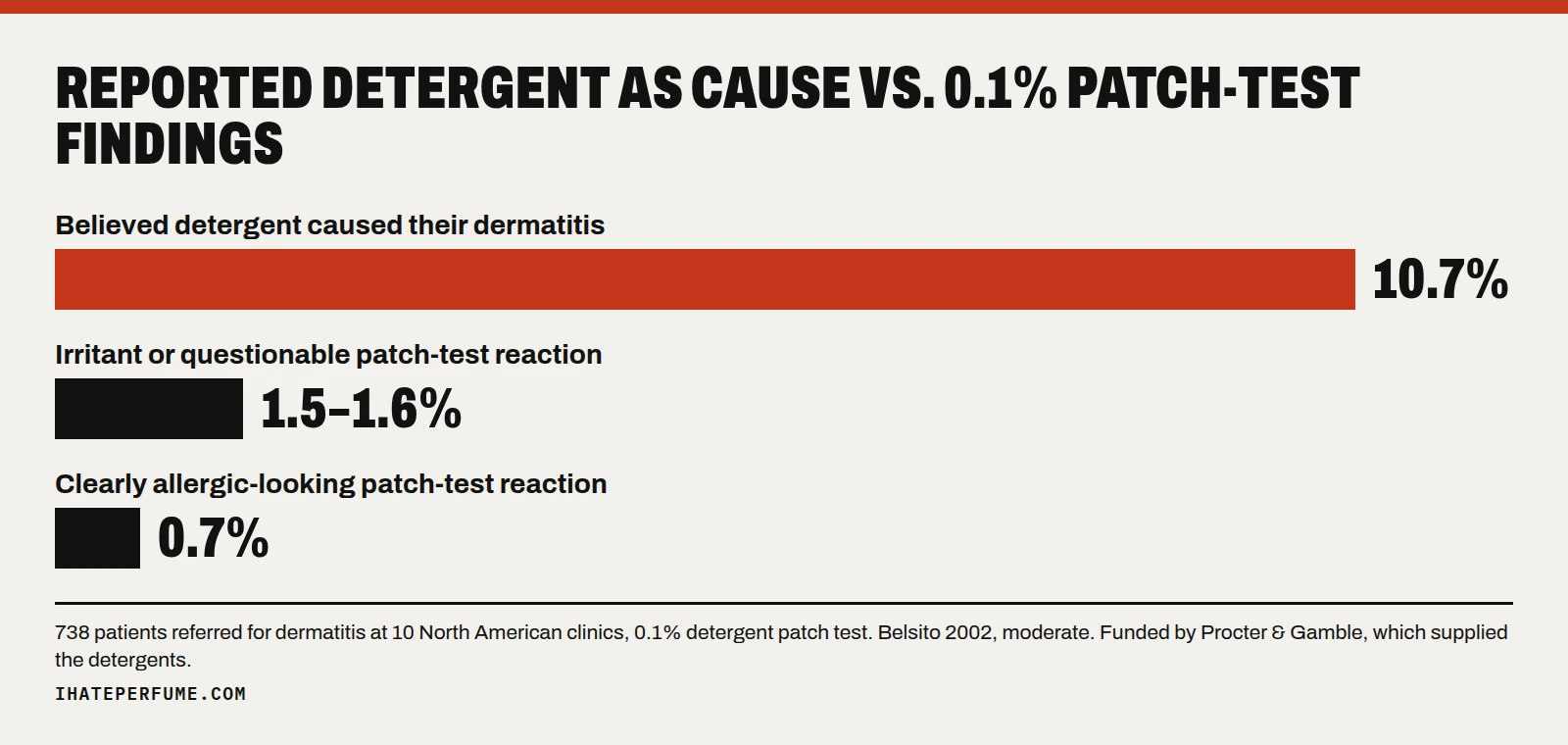
In one referred-clinic detergent study, reported attribution and allergy confirmed by the study’s patch-test protocol were far apart. That comparison does not show that patients’ symptoms were imagined.
Belief that one's dermatitis is caused by laundry detergent (10.7% of 738 referred dermatitis patients, and 8.4% of consumers in an earlier mail survey) is far more common than allergy confirmed by patch testing (0.7% in this study). Moderate evidence. Belsito et al. 2002 Industry-funded
In that study, the patch-test reactions that did show up leaned irritant.
At the 0.1% aqueous test concentration used for detergents, irritant or questionable reactions (11-12 patients, 1.5-1.6%) outnumbered clearly allergic-looking reactions (5 patients, 0.7%), showing these test concentrations already sit close to the irritant threshold, which limits how much higher a concentration could be used without generating false positives. Moderate evidence. Belsito et al. 2002 Industry-funded
Outside fragrance evidence, one weak, 21-patient rosacea study tested patients’ cosmetics and medicines.
Rosacea patients' own cosmetics and medicines almost never caused allergic reactions: 133 patch tests of patients' own products (21 patients) gave no positive reactions, only a few irritant or doubtful ones. Weak evidence. Jappe et al. 2008, JEADV
Separately, an industry-linked narrative review argued that some benzalkonium chloride patch-test reactions were irritant. Later clinics disagree.
A 2004 review by Unilever and London clinic authors concluded benzalkonium chloride (a common preservative and disinfectant) is a clear skin irritant and that many reports of allergy to it are probably irritant patch-test reactions misread as allergy. Weak evidence. Basketter et al. 2004 Industry-funded
In recognized occupational skin cases, irritant diagnoses outnumbered allergic ones
In the Danish recognized-case series and the occupational series summarized by one review, irritant classifications outnumbered allergic classifications. These are definition-dependent occupational figures, not a general split.
Among 758 recognized occupational hand eczema cases in Denmark (2001-2002), about 62% were purely irritant (mostly water and soap, i.e. wet work), about 21% purely allergic, and about 9% both. Moderate evidence. Skoet 2004
In Denmark, about 70% of recognized occupational contact dermatitis cases are attributed to irritant exposures and 30% to allergy; other occupational series cited in the review give 75% (Saarland notifications) and 57% (Northern Bavaria, plus 15% combined). Weak evidence. Jacobsen 2022

The occupational research names wet work, detergents, and disinfectants.
The review rates detergents and non-alcoholic disinfectants as moderate evidence for irritant contact dermatitis on their own, and strong evidence when combined with other wet work, because in most studies the exposures cannot be separated. Moderate evidence. Jacobsen 2022
In these studies, irritation needed no prior sensitization
The cited cinnamal experiment produced allergic reactions in already-allergic participants. The 20 non-allergic comparison users did not.
In a double-blind study, deodorants containing as little as 0.01% cinnamic aldehyde (cinnamal) triggered allergic skin reactions within weeks in people already allergic to it, while an identical unscented deodorant on the other armpit, and the same deodorants used by 20 non-allergic people, caused no reactions. Strong evidence. Bruze et al. 2003
The benzyl alcohol and benzoic acid tests produced non-allergic reactions without prior sensitization.
The cosmetics industry's own safety panel found that 5% benzyl alcohol and 2% benzoic acid provoke a non-allergic skin reaction (redness, swelling, itching) in most people tested with no prior sensitization needed, yet concluded both are "safe" up to 5% in cosmetics because it judged typical exposure limited, not because the reaction is rare. Moderate evidence. Nair 2001 (CIR Expert Panel) Industry-funded
Lung specialists draw the distinction for asthma.
Irritant-induced asthma is not an allergy: a single high exposure can trigger it without a sensitization latency period, and affected people do not react to low re-exposure of the same agent, though their airways can stay hyperresponsive for years afterward. Moderate evidence. Vandenplas 2014
Not an allergy doesn’t mean not serious, outside fragrance too
Non-fragrance occupational and acute-inhalation evidence shows that some irritant conditions can persist.
The review found strong evidence that complete healing of occupational irritant contact dermatitis is poor when exposure continues unchanged, and moderate evidence that healing is better after changing job or work tasks; in the largest Danish cohort 15% healed and 52% improved in those who stayed in their profession versus 19% and 67% who changed profession (4-5 years). Moderate evidence. Jacobsen 2022
After an acute inhalation accident, irritant-induced asthma persisted in one small follow-up cohort.
Irritant-induced asthma after an acute inhalation accident can be long-lasting: in a 14-year follow-up of 35 people, all still had respiratory symptoms, 68% used inhaled corticosteroids, and only 17% had recovered with normal spirometry and airway reactivity. Moderate evidence. Lemiere 2022
Where allergy is the answer
Irritation is not the whole story. Fragrance mix I contact allergy is well established among patch-tested dermatology-clinic eczema patients.
Fragrance ingredients rank alongside nickel as a leading cause of contact allergy in dermatology-clinic eczema patients, diagnosed in roughly 10-12% of those tested. Strong evidence. Johansen 2003, Am J Clin Dermatol 4(11):789-798
Two older US specialist cosmetic series counted mostly allergy.
In a 1977-1983 FDA-funded series of 713 cosmetic dermatitis cases seen by US contact dermatitis specialists, 81% were allergic (sensitization) and 16% irritant. Moderate evidence. Adams & Maibach 1985
A second cosmetic series found the same skew, and its authors called that skew an artifact of under-recording and incomplete testing.
Dermatologists diagnosed 80% of these cosmetic reactions as allergic contact dermatitis and 16% as irritant, but the authors call that skew an artifact because irritation was under-recorded and phototoxicity was not routinely tested. Moderate evidence. Eiermann 1982
What we can’t say yet
We hold no study that counts irritant and allergic reactions across the general public, and no graded split for lungs. The “80% of reactions are irritation” figure that circulates doesn’t trace to any source we hold. We’ve asked our research team to look for a general-population count.
What this means for you
A negative allergy test doesn’t make a reaction imaginary, and nobody should need an allergy diagnosis to ask for fragrance-free air. If scent stings your eyes or tightens your chest, the studies above say that can happen without classic allergy.
- Ask for fragrance-free air without a diagnosis. The take-action tools do the asking for you.
- Read how allergic and irritant findings sit side by side, how the skin evidence works, and what the lung studies show.
Every claim above shows its evidence grade and names its source. This article provides general information, not medical advice.