Your allergy tests come back normal, and the rash, the stinging eyes, or the tight chest is still there. “Normal” is not the same as “nothing is wrong.” Fragrance can set off allergic reactions, and it can set off irritant ones. They work differently, and “not an allergy” is no reason to wave a reaction away.
Evidence key Strong Moderate Weak How we grade
Two routes to the same reaction
Start with the allergic route. In these deodorant trials, only people who were already allergic reacted.
In a double-blind study, deodorants containing as little as 0.01% cinnamic aldehyde (cinnamal) triggered allergic skin reactions within weeks in people already allergic to it, while an identical unscented deodorant on the other armpit, and the same deodorants used by 20 non-allergic people, caused no reactions. Strong evidence. Bruze et al. 2003
A second chemical, the same pattern.
In a controlled study, deodorants containing hydroxycitronellal at 0.032% to 0.32% triggered allergic armpit rashes within a few weeks in all 7 people already allergic to the chemical, while an identical unscented deodorant on the other armpit, and the same deodorants used by 7 non-allergic people, caused no reactions (P<0.001). Moderate evidence. Svedman et al. 2003
Now the route that does not need an allergy. Pay attention to the reason the industry panel gave for calling it “safe.”
The cosmetics industry's own safety panel found that 5% benzyl alcohol and 2% benzoic acid provoke a non-allergic skin reaction (redness, swelling, itching) in most people tested with no prior sensitization needed, yet concluded both are "safe" up to 5% in cosmetics because it judged typical exposure limited, not because the reaction is rare. Moderate evidence. Nair 2001 (CIR Expert Panel) Industry-funded
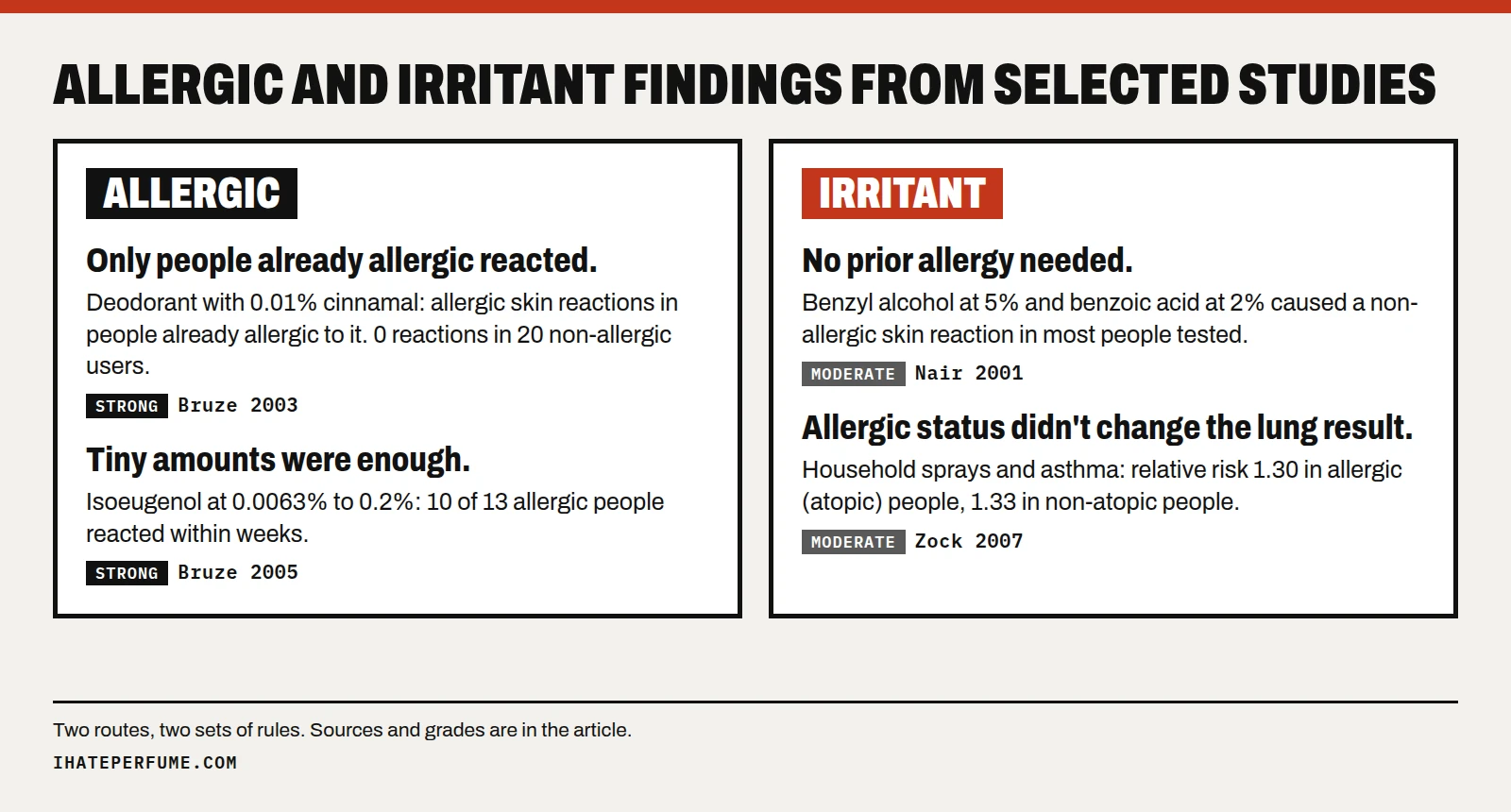
Side by side: in the deodorant trials, none of the small non-allergic comparison groups reacted. In the review of benzyl alcohol and benzoic acid, no prior allergy was needed.
“Not an allergy” is not the same as “not real”
A clean patch test is easy to hear as “so it’s nothing.” One referred-clinic study compared what patients suspected with what a specific detergent patch-test protocol found.
Belief that one's dermatitis is caused by laundry detergent (10.7% of 738 referred dermatitis patients, and 8.4% of consumers in an earlier mail survey) is far more common than allergy confirmed by patch testing (0.7% in this study). Moderate evidence. Belsito et al. 2002 Industry-funded
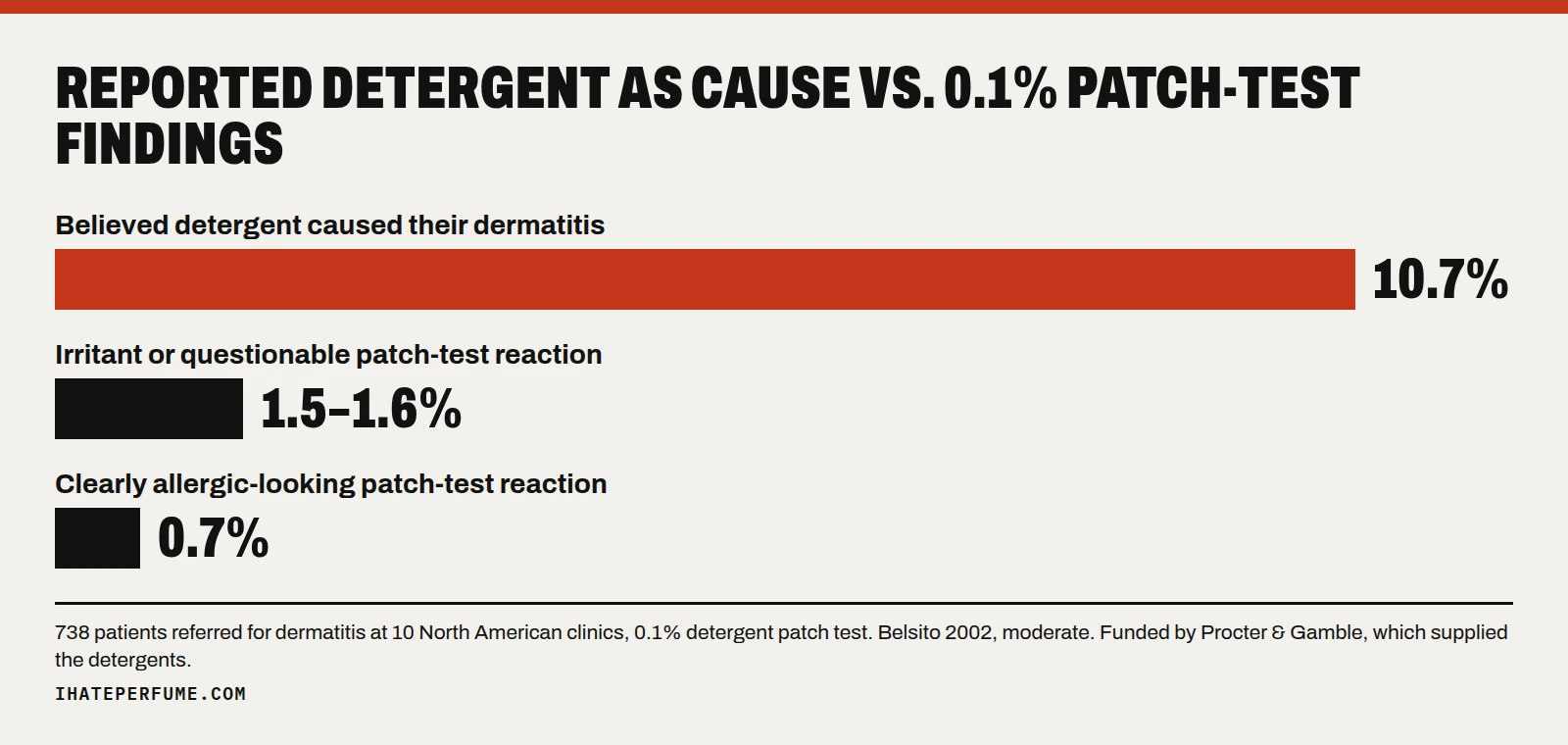
That gap does not show the dermatitis was imagined. Look at what the same study found next.
At the 0.1% aqueous test concentration used for detergents, irritant or questionable reactions (11-12 patients, 1.5-1.6%) outnumbered clearly allergic-looking reactions (5 patients, 0.7%), showing these test concentrations already sit close to the irritant threshold, which limits how much higher a concentration could be used without generating false positives. Moderate evidence. Belsito et al. 2002 Industry-funded
Then check who paid for the study.
This study — the largest and most-cited test of whether laundry detergents cause allergic contact dermatitis — was funded by Procter & Gamble, which also supplied both detergents tested and had previously conducted its own unpublished non-irritancy testing of the same test concentrations with one of the study's authors. Moderate evidence. Belsito et al. 2002 Industry-funded
What the breathing studies found
Ask the same question about the lungs. Standard allergy tests did not predict who reacted.
Standard allergy tests did not predict who reacted to fragrance; people with sensitive airways (including non-allergic asthma) were 2-4 times more likely to react, pointing to airway irritation rather than classic allergy. Moderate evidence. Elberling 2005
This next study is about household sprays in general, not fragrance alone, and it points the same way.
The household-spray-asthma association was not modified by atopy (allergic sensitization): risk was similar in atopic (RR 1.30) and non-atopic (RR 1.33) participants, supporting an irritant rather than allergic mechanism. Moderate evidence. Zock et al. 2007
Treat the next finding with care. It comes from a narrative review. Most of the irritants it covered were not fragrance, and its participants did not have moderate or severe disease.
A review of controlled chamber studies (carbon dioxide, ammonia, formaldehyde, sulfur dioxide, glycol/glycol-ether mixtures) found no consistent evidence that people with allergic rhinitis or mild asthma are more sensitive to sensory-irritant chemicals than non-allergic people. Moderate evidence. Nielsen & Wolkoff 2017 Industry-funded
A fuller look at the evidence is in Scent and your lungs: allergy or irritation?
A possible nerve pathway, mostly from lab work
If an allergy isn’t doing it, what is? One possibility runs through a nerve receptor that senses irritants.
In lab studies, common flavor and fragrance chemicals act directly on TRPA1, the nerve receptor that senses irritants such as mustard oil: cinnamon's cinnamaldehyde and thyme's thymol switch it on, while camphor and eucalyptus oil block it. Moderate evidence. Mihara & Shibamoto 2015
This weak review-level finding offers a possible explanation. It isn’t evidence that the mechanism operates at household exposure levels or explains any one person’s symptoms.
Many everyday chemicals, including some released by scented and cleaning products, act on the same irritant-sensor nerves in the nose and airways (TRPA1 and TRPV1), one reason very different products can cause similar symptoms. Weak evidence. Molot 2023
Why “hypoallergenic” on the front of the bottle settles nothing
The word “hypoallergenic” does not guarantee a cosmetic is free of allergy risk.
The US FDA has no directive at all regulating the use of the word 'hypoallergenic' on a cosmetic product, and in a 2015 survey the products so labeled had the highest contact-allergen rate (88.2%) of any of four marketing terms tested (hypoallergenic, dermatologist recommended, fragrance free, paraben free). Strong evidence. Hamann 2015
Europe’s own guidance says so too.
EU guidance says a 'hypoallergenic' cosmetic claim requires the company to actively rule out known and suspected skin sensitizers through six named routes (including its own consumer-complaint records) and states plainly that the claim 'does not guarantee a complete absence of risk of an allergic reaction'. Moderate evidence. EC Technical Document on Cosmetic Claims 2017 Industry-funded
What we can’t tell you yet
You’ll often hear that most reactions to fragrance are irritation, not allergy. We have not found a graded study that estimates the allergy-versus-irritation split for fragrance reactions. Referral-clinic studies of textile dermatitis and benzalkonium chloride don’t answer that question. So we won’t hand you a percentage. What the studies above do show is narrower: in these studies, a reaction can happen without an allergy. We’ll update this page if a graded source turns up.
What testing can show
Testing can still help, even though it can’t settle everything above.
If you get recurring rashes, ask for patch testing: nickel and fragrance are the most common findings in the general population, and one fragrance test alone misses many fragrance allergies. Moderate evidence. Alinaghi 2018
What you can do
- You shouldn’t have to prove a particular diagnosis before asking for fragrance-free shared space. The take-action tools help you ask for one.
- See how the skin evidence works in allergic or irritant rash, and whether fragrance-free policies work.
- The full argument is here: Allergy or irritation? Why the studies keep pointing to irritation
Every claim above shows its evidence grade and names its source. This article provides general information, not medical advice.