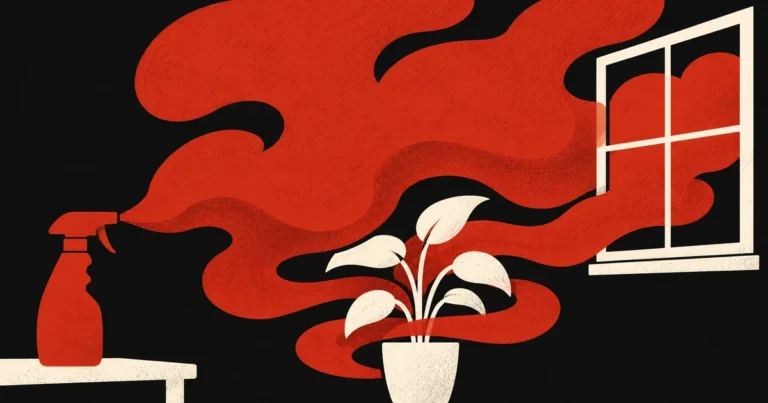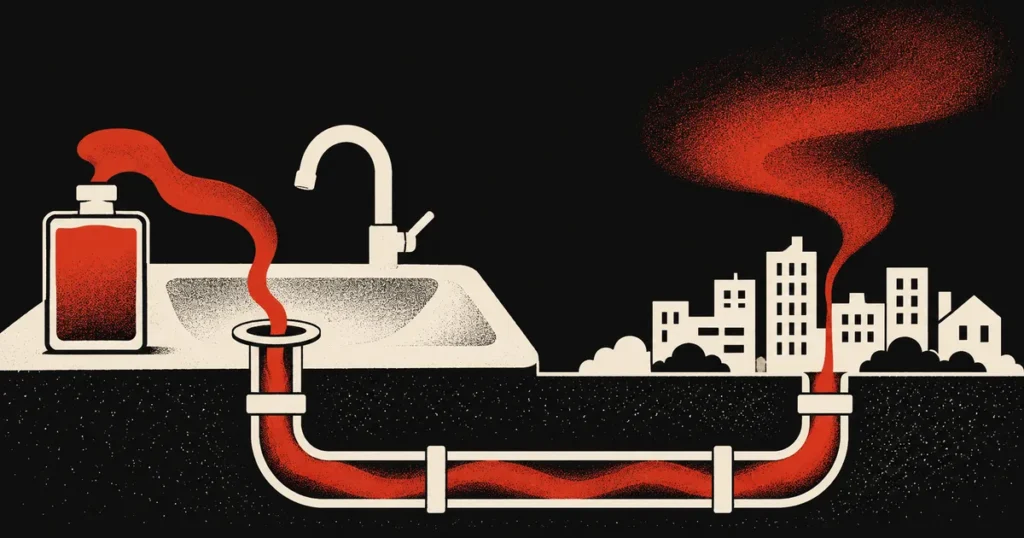
You rinse it off, you pull the laundry out of the dryer, you open a window, and the smell is gone. It isn’t gone. Researchers have followed scent down the drain, out the dryer vent, and into the air over whole cities. Here’s what they found, and why the industry’s “fresh” ends up as everyone’s problem.
Evidence key Strong Moderate Weak How we grade
Down the drain
About 60% of the fragrance used in homes goes down the drain into rivers and lakes, and wastewater treatment removes little of it; polycyclic musks such as galaxolide turn up in rivers, lake air, mussels, and human milk. Moderate evidence. Khalid & Abdollahi 2021
One test of a rinse-off conditioner found part of an ingredient going straight into the wash water.
A rinse-off, in-shower hair conditioner discharged an estimated 40% of its applied D5 dose directly into wash water within 1-3 minutes of application, far more than any leave-on product tested. Moderate evidence. Montemayor 2013 Industry-funded
One report flags two ingredients found in perfumes as environmentally problematic.
The UV filter ethylhexyl methoxycinnamate, found in several of the tested perfumes, and limonene, one of the most common fragrance ingredients, are both flagged by this report as environmentally problematic; the EU classifies limonene as very toxic to aquatic life. Moderate evidence. Tegengif 2022
Out the dryer vent
The sheet in the dryer doesn’t keep its scent to itself.
Scented laundry products put fragrance chemicals into outdoor air: in two homes, limonene (a citrus scent chemical) came out of the dryer vent only when fragranced detergent or dryer sheets were used (up to 14.7 ug/m3), not in the no-product runs. Moderate evidence. Steinemann 2013
The vent carries more than scent.
Even with a dryer's lint trap in place, tens of milligrams of lint still escape out the vent into outdoor air per drying cycle (35 mg at one home, 70 mg at a second home, averaged over three cycles). Moderate evidence. Kapp & Miller 2020 Industry-funded
A home field study found that microfibers from a clothes dryer travel through outdoor air and land on the ground at least 30 feet from the vent, though most land within about 5 feet. Moderate evidence. Kapp & Miller 2020 Industry-funded
One modeling estimate scaled the vent numbers up to whole regions.
If households switch from fragranced to fragrance-free laundry detergent, modeling suggests dryer-vent limonene emissions across a whole city or state could drop substantially — an estimated 1.58 tons per year for metropolitan Melbourne, or 8.66 tons per year for the state of California. Weak evidence. Goodman, Nematollahi & Steinemann 2020/2021
More on what laundry scent does next door: scented laundry and dryer vents.
A fingerprint in city air
Scientists can tell which products are in the air, because the products leave signatures.
Scientists can identify which everyday products are polluting a city's outdoor air just by measuring a handful of specific chemical fingerprints: a silicone compound (D5-siloxane) for personal-care products and citrus/pine-scent chemicals (monoterpenes, mostly limonene) for fragranced products, confirmed by mobile-lab measurements across New York City, Pittsburgh, Chicago, and Denver. Strong evidence. Gkatzelis 2021
One personal-care ingredient even keeps a schedule.
A silicone ingredient in everyday deodorants, lotions, and hair products (D5) shows up in city outdoor air on a clear morning schedule tracking when people shower and dress for work, peaking around 6-7 AM and fading over the following several hours. Moderate evidence. Coggon 2018
Put that next to the morning commute.
During the morning rush hour in a US city, the mass of a personal-care-product ingredient (the silicone D5) entering outdoor air can exceed 30% of the mass of benzene entering the air from vehicle traffic, and the city-wide daily D5 emission total is in the same order of magnitude as the city's traffic-benzene emissions. Moderate evidence. Coggon 2018
The more densely populated a US city center is, the higher its outdoor air levels of personal-care and fragrance-product chemicals relative to traffic pollution, a pattern found consistently across four different cities. Moderate evidence. Gkatzelis 2021
In summer Manhattan, citrus/pine-scent chemicals from fragranced products reached an outdoor air level comparable to benzene, a chemical that mostly comes from vehicle exhaust, even though the two come from completely different sources. Moderate evidence. Gkatzelis 2021
Consumer products are part of the smog problem
California’s air regulator counted consumer-product emissions in Los Angeles.
In the Los Angeles air basin in 2005, consumer products such as hair spray, cleaners, and perfumes were the second-largest human-made source of organic gases by weight (118.7 metric tons a day), behind only passenger cars, according to California's air regulator. Moderate evidence. Chen & Luo 2012
Even after accounting for how readily each chemical forms smog, consumer products ranked third among all emission sources in the Los Angeles basin in 2005. Moderate evidence. Chen & Luo 2012
Perfumes and colognes alone released about 2.5 metric tons of organic gases a day into Los Angeles air in 2005, not counting fragrance in cleaners, air fresheners, or hair spray. Moderate evidence. Chen & Luo 2012
New York shows the same pattern.
In New York City, everyday chemical products (paints, glues, cleaners, personal care) release about 50% more smog-forming vapor by weight than vehicles and other fossil fuels, and their tracers (D5-siloxane, ethanol) rise with population density across US and European cities. Moderate evidence. Coggon 2021
On New York's worst smog day of 2018, consumer and industrial chemical products added about 11 ppb of ozone to a 114 ppb regional peak (standard: 70 ppb), slightly more than vehicle and industry fuels (8 ppb). Moderate evidence. Coggon 2021
In most U.S. cities, everyday chemical products likely account for 50 to 80% of the outdoor smog-forming and particle-forming potential from human activities, rivaling or exceeding vehicle traffic almost everywhere except the least densely populated areas. Moderate evidence. Gkatzelis 2021b
The smog rules have a gap, and the labels say “green” anyway
US product rules written to limit smog (ozone) exempt several chemicals that still form fine particles, and fragrance ingredients do not have to be disclosed. Moderate evidence. McDonald 2018
And a “green” label isn’t proof of anything.
A 2009 audit of 2,219 North American products making green claims found that more than 98% made at least one misleading or unsupported environmental claim. Moderate evidence. Dahl 2010
Released indoors, it’s far more likely to be breathed in
Now move the same release indoors, where the math changes.
A chemical released indoors is roughly 1,000 times more likely to be breathed in than the same amount released outdoors (exact when comparing the low end of each range; only ~100x at the high end, since the ranges overlap at 10⁻³), so cleaning products and air fresheners (about 1% of California's smog-forming emissions) may deliver an inhaled dose on the same scale as all outdoor sources combined. Strong evidence. Nazaroff & Weschler 2004
What you can do
- Switch to fragrance-free laundry detergent and skip dryer sheets. It’s the change that reaches past your own walls.
- Use less product, and fewer scented ones, especially rinse-off products that go straight down the drain.
- Don’t trust “green,” “eco,” or “natural” on the label. Check ingredients with our label decoder.
- Ask your city, school, and workplace to buy fragrance-free cleaning and laundry products. Take action has ways to ask, and the pledge is a place to start.
- More on where fragrance ends up: perfume in your blood and what’s in a bottle of perfume.
Every claim above shows its evidence grade and names its source. See all the facts and the claims we won’t make. Information, not medical advice.