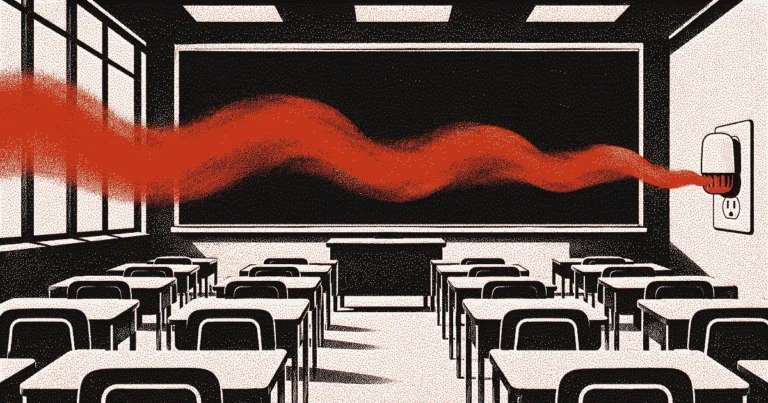
You spray the counter with the lemon cleaner, wipe it down, and the kitchen smells clean. The smell isn’t the end of it. When ozone is present, some scent chemicals keep reacting in the air and make new compounds that were never in the bottle. Below is what researchers have measured so far, and where the evidence stops.
Evidence key Strong Moderate Weak How we grade
What you breathe isn’t only what was in the bottle
Here is the idea in one sentence.
What you breathe after using a scented cleaner is not only what was in the bottle: the scent chemicals keep reacting in the air to make new compounds. Strong evidence. Chen & Hopke 2010
Researchers keep finding the same reaction.
Scent chemicals such as limonene and pine oil react with ozone indoors to make new pollutants, including formaldehyde and fine particles, that keep forming for hours after cleaning ends. Strong evidence. Nazaroff & Weschler 2004
A test in a real house found it too, using a cleaner exactly as the label directed.
In a real test house, using a limonene-scented foam cleaner exactly as the label directed produced a burst of 45,000-150,000 tiny new particles per cubic centimeter within minutes, but only when ozone was in the air. Strong evidence. Rossignol 2013
It isn’t one lucky experiment, either.
Scented cleaners react with ozone indoors and release bursts of tiny new particles; every study able to separate them found this. Strong evidence. Salonen 2024
In one test room, the change lasted long after the cleaning stopped.
After 2-7 minutes of cleaning with a terpene cleaner, indoor air chemistry stayed altered for 10-12 hours because the scent chemicals soaked into walls and floors and came back out. Moderate evidence. Singer 2006
One chamber test added ozone to a mix of indoor chemicals. The caveat matters here, so read it.
When 40 ppb of ozone was added to a room holding a mix of 23 common indoor chemicals, including the citrus and pine scent chemicals limonene and alpha-pinene, formaldehyde tripled (13 to 40 µg/m³), ultrafine particles rose about 18-fold (2,500 to 46,000 per cm³) and particle mass reached 140 µg/m³. Moderate evidence. Fiedler 2005
In two small lab studies, limonene mixed with ozone raised eye-blink rates at far lower levels than limonene alone.
Pure limonene only irritates human eyes at about 445 mg/m³, far above indoor levels. A limonene-ozone mixture reacted for just 10 minutes raises eye-blink rates at roughly 1,000-2,000x less limonene: Klenø & Wolkoff (2004, n=8, primary) found residual 0.42 mg/m³ limonene + 0.08 mg/m³ ozone raised blink frequency 42% (P<0.0001); Nøjgaard (2005, n=10, primary) found a lower dose, 0.23 mg/m³ limonene + 0.08 mg/m³ ozone, gave a smaller but still significant +17% (p=0.003). Moderate evidence. Wolkoff 2013
Scent chemicals are a signature of indoor air
Now look at what turns up in offices, classrooms, and childcare rooms.
Limonene was 13x higher indoors than outdoors in European offices and classrooms, one of the two highest indoor/outdoor ratios of 23 chemicals measured. Strong evidence. Geiss 2011
Childcare rooms are no different.
Limonene was detected in every childcare room studied and was more than 1,000 times higher indoors than outdoors, so it came from products used inside. Strong evidence. Hoang 2016
Clean outdoor air doesn’t keep them out.
Even in Perth, a city with very clean outdoor air, limonene and pinene (scent chemicals typical of citrus- and pine-scented cleaners and air fresheners) were found in 80-100% of homes when a sensitive test was used. Strong evidence. Maisey 2013
They show up in city air, too.
In winter Manhattan air the dominant terpene was limonene, the citrus scent chemical used in cleaners and personal care, while nearby forests gave off pine-type terpenes: scented products are a measurable source of city air pollution in New York. Moderate evidence. Coggon 2021
Why indoor releases matter more
Where a chemical is released matters. Monitoring studies show where people actually get their dose.
Across decades of US monitoring where people carried personal air samplers, the air they breathed held more of almost every hazardous chemical than outdoor air did: exposure happens indoors, not at the outdoor monitoring station. Strong evidence. Weisel 2002
Put numbers on that, and the cleaning aisle looks different.
A chemical released indoors is roughly 100 to 1,000 times more likely to be breathed in than the same amount released outdoors, so cleaning products and air fresheners (about 1% of California's smog-forming emissions) may deliver an inhaled dose on the same scale as all outdoor sources combined. Strong evidence. Nazaroff & Weschler 2004
What this does and doesn’t mean
We owe you the result that cuts the other way. Read it next to its caveat.
In the largest controlled test of its kind, 130 healthy young women breathing an indoor chemical mixture with and without ozone for 140 minutes showed no significant change in symptoms, lung function, attention, or the stress hormone cortisol. Strong evidence. Fiedler 2005
Researchers haven’t yet shown how much of this harms people at everyday home levels. Many of these measurements come from lab chambers and test rooms. That is a reason to keep studying it, and a fair reason to ask for fragrance-free options while they do. We list the overstatements we won’t make about indoor air on our myths page.
Air fresheners
Ask people how they react to air fresheners.
About 1 in 6 adults (17%) in four countries said air fresheners or deodorizers make them unwell; of those, half reported breathing problems. Moderate evidence. Steinemann 2019
41% of US adults with asthma reported health problems from air fresheners, and 36.7% said they can't use a public restroom that has one. Moderate evidence. Steinemann 2018
What you can do
Choose fragrance-free cleaners. Look them up in EWG’s Guide to Healthy Cleaning, and use our label decoder to check the label.
Fix odors at the source instead of covering them up. A public-health agency says the same.
The California Department of Public Health recommends enforced fragrance-free workplace policies, no air fresheners or fragranced cleaners, and better ventilation instead of odor masking. Moderate evidence. Weinberg 2017
Take used wipes and paper towels out of the room when you’re done.
Leaving used paper towels in the room after cleaning increased the solvent and scent chemicals released by 35-100%. Moderate evidence. Singer 2006, Indoor Air
Don’t run an ozone-generating air purifier or ionizer alongside scented cleaners or air fresheners.
How much formaldehyde and particle pollution formed was set mainly by how much ozone was available, not by how much product was used, so running an ozone-generating air purifier or ionizer alongside scented cleaning products or air fresheners adds directly to indoor formaldehyde and particles. Moderate evidence. Destaillats 2006
Want the room-by-room version? See our room-by-room guide.
Every claim above shows its evidence grade and names its source, with a link wherever one exists. See all the indoor air facts. Information, not medical advice.
Videos, fact-checked